
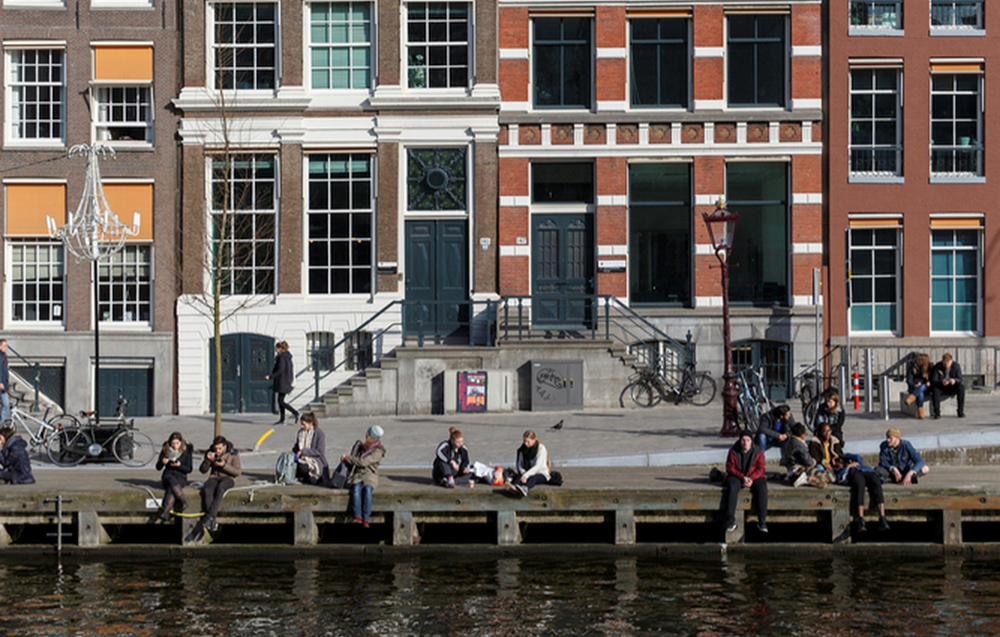
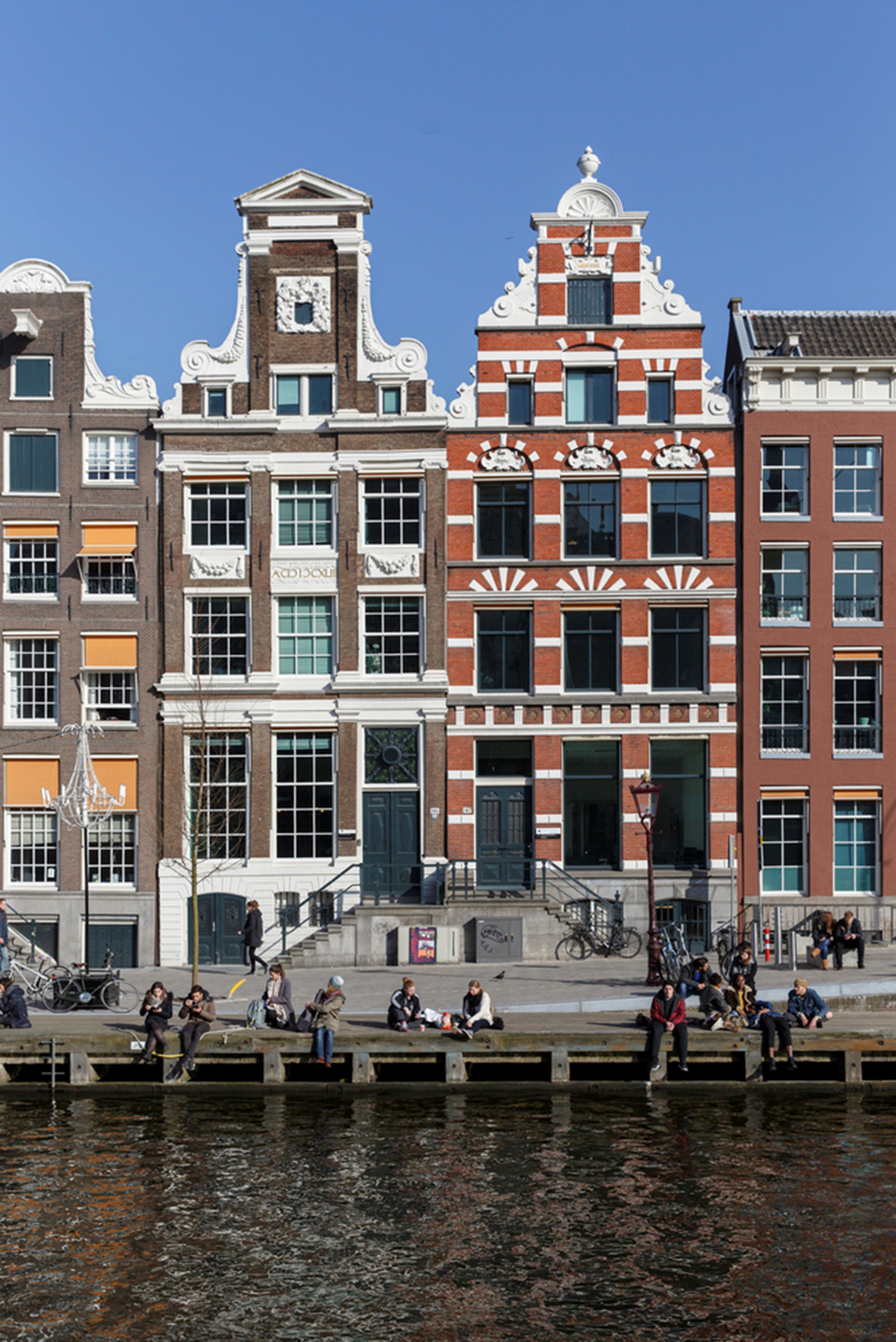
A modeller from the UK, a marine biologist from the Netherlands, and a policy analyst from Estonia meet in Amsterdam… What may sound like the beginning of an anecdote is in fact a snapshot of 40 individuals, mostly from Europe, meeting on the (sunny!) banks of one of Amsterdam’s canals, coming together for a week to learn about and discuss amongst themselves and invited experts the complexities of the ever-looming climate crisis.
The aim of the first ever Amsterdam Complexity School on Climate Change, organised by the University of Amsterdam’s Institute for Advanced Studies, was to focus on collaboratively tackling challenges related to climate change; as one of the participants I believe this aim was well achieved!
The main goal was to feature lectures, tutorials, and panel discussions by researchers, policymakers, representatives of NGOs, activists, and others while enabling participants to collaboratively tackle challenges related to climate change. In practice this means that participants proposed certain topics that were then dissected in discussions with the intention to select a couple on which several teams worked throughout the rest of the week. On the last day, the groups presented their outcomes, thematically ranging from the simulation of food system governance to the pillars of the fossil fuel industry, or media coverage of scientific and knowledge products.
Swiftly tayloring a beyond–carbon tunnel vision
In my group we focused on high-profile leaders’ power and potential to incentivise societal-wide behavioural change by adopting a visible high-impact low-carbon approach. And, correct, we did focus on one of today’s most famous globe-trotters, Taylor Swift. What relevant scenario to decrease greenhouse gases can we apply in order to modelling possible? Diet, flying, offsetting, political influence over the upcoming US presidential elections, or logistics in terms of keeping the number of concerts the same but at fewer destinations? Naturally, due to so many factors it was impossible within one week to model the precise results. However, the main take-away for me was the hands-on experience gained while discussing research strategies in a truly interdisciplinary manner. Moving beyond the carbon tunnel vision is more than necessary in a world with intertwined crises, ranging from biodiversity loss to illiberal and authoritarian tendencies.
Presentations, discussion, food for thought and so much more
A significant part of the week was dedicated to discussions with experts. With a background in International Relations, International Public Management and Climate Diplomacy, I found the number of speakers focusing on climate-related policies especially captivating.
For instance, Prof. dr. Detlef van Vuuren dived into different layers of looking into the evolution of future systems – via models (based on physical entities), scenarios (working with rules, laws, behaviours), and storylines (including beliefs, culture, etc.), while not shying away from the IPCC-supported fact that although current policies could slow down emission growth, they will not lead to (necessary) fundamental transition. Specifically, he reminded us that “without negative emissions, at current rates of emissions, the carbon budget for 1.5C will be exceeded within 6 years.” That said, what must be taken into consideration is climate justice and geopolitics. This means that while in theory one can easily demand coal phase-out as the most efficient option to reduce greenhouse gases, it is also necessary to look at the historical responsibility, especially of the so-called Global North countries, currently disproportionally “running” mostly on oil and gas. The grim prospects of staying below the safe 1.5°C temperature increase are therefore further dimmed by the incredibly unequal world that we live in. Not only are inequalities not decreasing, but they are deepening – and the hidden assumptions in modelled pathways based on cost-efficiency may not always be helpful.
Coming around to solutions; it was overall inspiring that the focus was not on individual heuristic approaches, but instead on highlighting the dynamic ecosystem of actors (that we are part of) that has a role to play. For instance, Kornelia Dimitrova from Foundation We Are presented several projects where designers and scientists worked together and provided an (“artsy”) angle on unorthodox and refreshing questions such as the possibility of freezing the same amount of ice that has been melting. On a more theoretical note, Professor Marten Scheffer focused on reaching crucial tipping points that may “tip us out of trouble”. What is essential are social norm changes as well as policies that help shape social norms potentially turning vicious cycles of socially damaging behaviour into virtuous ones. Sharing her experience on global environmental governance, Professor Aarti Gupta further stressed the necessity to apply ourselves earnestly to explore accountability, responsibility, and equity within the climate regime. The intriguing discussion on the creeping normalisation of solar geoengineering provided great insights into its governance implications, political challenges and the way forward. Not yet well-known, the initiative advocating for the International Non-Use Agreement on Solar Geoengineering deserves attention in light of the risks associated with the set of speculative technologies that aim to lower global temperatures by artificially intervening in the climate systems of our planet.
One of the main take-aways for me, as someone relatively new to academia, was the lesson provided by Dr. Marthe Wens. Building on intellectual integrity, Dr. Wens shared insights from the initiative Scientists Rebellion that brings together scientists who feel that writing academic papers and speaking at conferences are no longer effective ways of tackling the climate crisis. In fact, scientists can be so much more active in shaping the way the world looks around them. Several examples include supporting activist groups, providing expert testimony, lobbying for change inside and outside of universities, writing opinion pieces, talking to by-standers and policymakers, or joining and leading protests. The scale of possible actions is diverse, and it was inspiring to see first-hand examples of how more and more scientists dare to leave their ivory towers. Additionally, despite so much knowledge already produced and on the table, being inactive also sends a message, with many of us still failing to see all the agency (or responsibility?) that comes with being a scientist.
The Amsterdam Complexity School on Climate Change was an inspiring experience that enabled the participants to discuss not only the latest science, but also governance and activism. One successful example from the Dutch capital reminded us that evidence and data are not enough to bring about change. Specifically, without mass protest and collective action against the domination of cars, the Dutch cycling policy and the proper infrastructure would have not existed. With the polycrisis around us, it is clear that all activities are essential to bring about transformational solutions, as they are all parts of the bigger puzzle.
Many thanks to the organisers of the first ever Amsterdam Complexity School on Climate Change and their energetic, friendly, and professional approach and support!









 SustainableCZ
Leave a comment