
A lot of the work in our department dives into the realms of behavioural psychology theories, in designing interventions which could lead to positive behavioural changes (for example PLUSchange) to benefit and protect our natural world. For example, some of our research asks the question, which interventions are most effective in bringing about pro-environmental behavioural change in society? Within this perspective of behavioural psychology, we understand the crucial importance of attitudes and values and how, as they drive our behaviours, they can ultimately impact each and every decision we make in our lives. My recent personal experiences over the last year have led me to realise however, that this is not just about science and theories… this is connected to something much deeper.
Do not get me wrong – I am a strong, ardent scientist at heart, but I still have feelings and values and morals, and I am beginning to finally learn that those feelings, values and morals are what drive my actions: in the same way as we study the values and attitudes which drive human behaviour in our research in the department. Indeed, I am still moved by the beauty of looking at rays of sunshine shimmer down through the clouds; I marvel at the agility and skill of a hovering kestrel; And I do what I do, not just because it’s interesting to me, but because I feel a moral obligation to do all I can to protect our natural world, and on top of that, I feel a great deal of love for it. In fact, this led me to where my current postdoctoral research lies: in trying to understand the development of nature connectedness and subsequent values for nature in young children. However, as I reflect on my personal journey, I realise I am beginning to think with my heart as well as with my head.
So, it was incredibly exciting and quite moving to see that a similar approach is being advocated and encouraged in academia, in the Nature-based Solutions Conference in Oxford that I attended online, earlier this year. At the conference, I truly felt that our traditional scientific practice was being revitalised with something we haven’t traditionally considered as scientific…and it was extremely refreshing!
In one of the opening speeches, Dr. Najma Mohamed encouraged us to bring our heads to the table, but also our hearts to listen, as well as our hands for action… Throughout the conference, speakers asked questions such as: What if we challenged ourselves to practise true values-based science and policy? What if we brought our whole selves to our work and to the table? How can we encourage leaders and decision-makers to do the same? In case you are unsure what I mean by those questions, I can paraphrase what Justin Adams (one of the conference organisers) said in his closing remarks: “While reconnecting to each other, to yourself and to Mother Earth, we must remember our kinship and how we are all connected. Because from that place, we really can re-imagine a brighter future. And we need to do that by holding hands, building bridges, between and within the scientific community, our traditions and our musicians…” As Nicole Schwab also described during her speech: “We need our analytical and critical minds, but we need to remember they are just a piece of what we need…we [also] need to shift from the anthropocentric view to an ecocentric view, where nature is not something out there but instead, we are part of it and it is part of us. We need to re-weave ourselves back into the web of life.”
This did not feel like a traditional academic conference. However, here we were, at one of the most respected universities in the world, with some of the most respected scientists present, and we practised deep breathing to centre ourselves between sessions; The conference organisers carried out deeply moving rituals based on ancient, indigenous and spiritual practices; A sacred fire was lit at a ceremony at the beginning of the conference, and fire keepers sat overnight throughout the 3 days taking care of the fire, to help hold the intention of the conference, “so that something magical might emerge and we could step out of this space braver and more courageous for our agenda to move forward” (as spoken by Justin Adams).
The meeting was hugely interactive, with in-person and online attendance from a massive range of backgrounds: artists, indigenous leaders, musicians, lawyers, people working in finance, government, NGOs, as well as the academics. The bringing together of people through meditation, or music, or through the ceremonies (as an online attendee I admit, I heard about it more than experienced it first-hand, but I could attend some of these activities and I still felt engaged and involved and moved); I think what this conference did so well, was to try and touch us as individuals, on a personal, emotional as well as intellectual way – and this is something I haven’t experienced before in my academic career. They provided a safe space for nurturing this personal power and spirit.
The thing is, we are all connected to the Earth, to nature. So, to encourage scientists and even policy-makers and decision-makers to bring their hearts to the table when facing our global environmental crises, is really not as complicated as we might think. It might be as simple as taking off your shoes and stepping on the grass; or washing your face in the cold fresh water of a mountain stream; or just stepping outside on a cold, crisp morning and closing your eyes as the sunlight warms your cheeks. How exactly we can encourage others to re-connect to nature, to themselves, to their passion and to their ancient roots, I am keen to explore further. Indeed, Florent Kaiser (from Acción Andina who spoke at the conference) said (and I paraphrase): “The only thing that transcends generations is culture…we should understand the deep, ancestral principles that unite people and unite the people with their planet.. This is sometimes very far away from the financial and the scientific worlds…but this matters… they transcend this all.”
This is where I see our work moving to in the future: Perhaps, within science and policy and practice, we should be engaging at the individual level more. This will lead to stronger and deeper connections, to better and deeper understandings, and more effective and deeper and lasting action which will align much more closely to the moral obligations we hold with future generations. Perhaps this is just the start of a new revitalized scientific practice… I have even felt a similar approach as I attended the recent Conservation Optimism Summit, also held at the University of Oxford, where again many well-known experts in the field participated.
What I have learnt, is this: While we pursue our incredible intellectual journeys and use science to expand our knowledge and build our toolkit for facing the world’s environmental crises… don’t forget to lead with your heart. It will push you further, connect you closer and have the most lasting, positive impact.
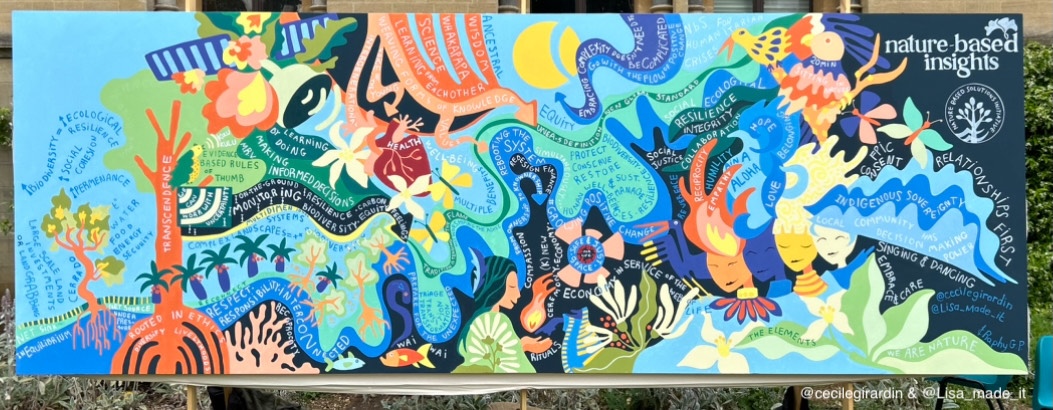
With thanks to the artists @cecilegirardin & @Lisa_made_it and sponsors @naturebasedsolutionsinitiative & @naturebasedinsights for permission to also share a photo of the beautiful mural created during the NbS Conference.







 SustainableCZ