

↪️ Česká verze příspěvku zde.
On 21 January 2025, a research workshop was held to explore possible pathways to transform the energy sector and food systems in the Czech Republic towards sustainability. The workshop was organized by the Department of Socio-Ecological Analysis of the Global Change Research Institute CAS (CzechGlobe). Apart from the research team, a group of ten stakeholders from various transformative initiatives, networks, and social enterprises operating in the Czech Republic participated in the workshop. The workshop aimed to collaboratively identify specific interventions and subsequently link them into causal chains – pathways – that would have the potential to strengthen the transformation of the said sectors on a broader scale. To stimulate initial discussion and data collection during the workshop, the research team also used innovative methods with gaming elements. The second workshop drew on the findings and collected data in the earlier stages of the research.
The full-day workshop, which was a part of the international research project Horizon Europe Transpath, was introduced by researchers Zuzana V. Harmáčková, Lenka Suchá, and Pavlína Schultzová, who first briefed the participants with a summary of the previous research phases. They pointed out that the initial phase of the research involved mapping the factors that could potentially amplify or weaken transformative changes in food systems and the energy sector at the level of consumers, producers, and organizations. During the first workshop, held in May 2024, stakeholders worked together in groups to map the links between these factors. From the co-produced maps, a computer model was created during the workshop with the help of Kasper Kok, an expert in the Fuzzy Cognitive Mapping (FCM) method from Wageningen University & Research, the Netherlands. The model showed that the dynamic in the Czech energy sector as described by the participants is significantly more favorable for transformative change than the dynamics in the agriculture and food systems sectors.
This second workshop builds directly on those findings. The research team first selected the most influential feedback loops (mechanisms of transformative change) that drove the FCM maps created at the first workshop. After a detailed description of these loops, the participants decided which of the loops they wanted to work with. Consequently, two groups were formed – one focusing on the influence of top-down factors (e.g. lobbying, political support) and the other on the influence of bottom-up factors (e.g. connecting consumers with producers, the power of small players). Based on these feedback loops, participants reflected on specific measures (interventions) that could harness the dynamics of these loops and support their transformative potential. To stimulate the discussion, the research team also used innovative research methods with incorporated game elements, such as the Snakes and Ladders game, including potential opportunities and barriers that could influence the transformative processes within the two sectors. Using the data gathered during these exercises, the workshop participants chronologically/causally linked the brainstormed measures into so-called transformative pathways.
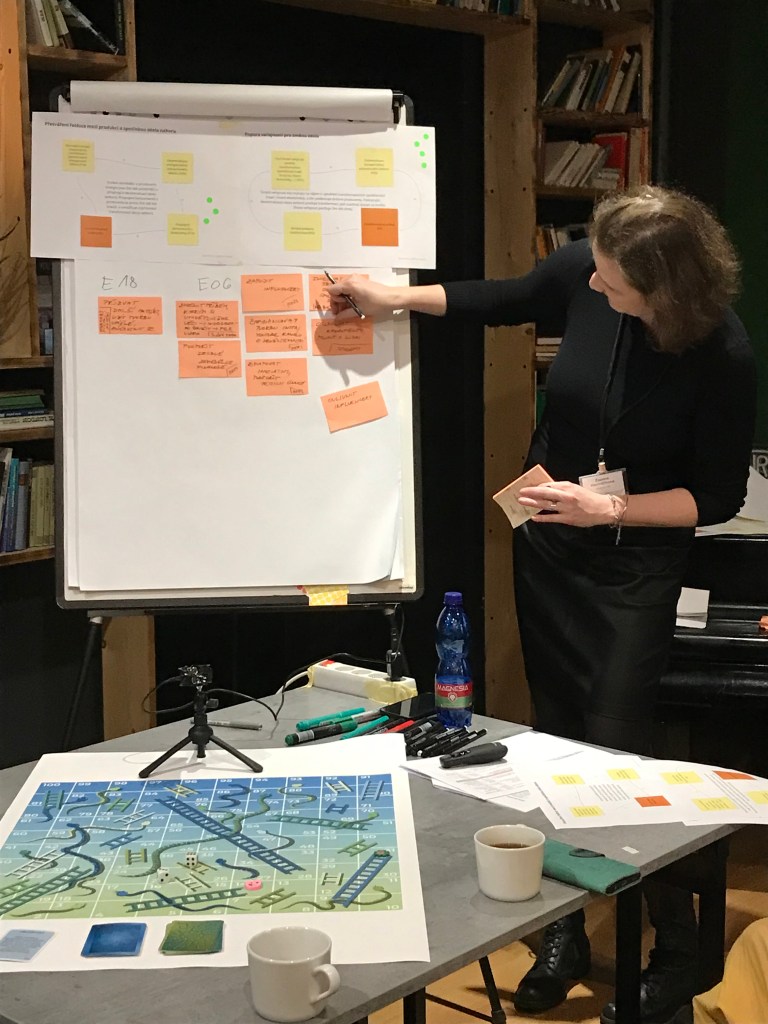

After three interactive sessions, in which the research team and participants collected, sorted and organized the data, the outcomes of the two groups were presented. The workshop concluded with a final discussion when the participants had the opportunity to share their feedback and main takeaways for them as well as their work.
The workshop was also attended by several colleagues from abroad, who are collaborating with the CzechGlobe research team on the TRANSPATH project. In addition to the aforementioned Kasper Kok from Wageningen University & Research, Eszter Kovacs and Lucy Fisher from University College London joined as well. The continuity and depth of the expert discussion were also supported by the fact that many of the stakeholders present at the second workshop had participated in previous parts of the research.
The research is being conducted as part of the international TRANSPATH project, which aims to find ways to scale up climate and biodiversity-friendly behavior. Among other things, TRANSPATH addresses the question of how transformative pathways can be developed in the different contexts of Western and Eastern Europe. It is coordinated by the Dutch institution Wageningen University & Research and involves 12 partners from 9 European countries. More information about the project can be found on the TRANSPATH website.
Co-author: Pavlína Schultzová







 SustainableCZ