
↪️ Česká verze příspěvku zde.
Threats to pollinators and pollination services that support agriculture and provide benefits to people are a worldwide problem. This is recognised by scientists, national or transnational initiatives, and even policies. A team from our department at CzechGlobe has joined a new project that aims to help agriculture to become a positive force for pollinator biodiversity, crop pollination services and co-benefits to ecosystems and people.
The project kick-off took place in Brussels last month. Coordinated by the French National Research Institute for Agriculture, Food and the Environment (INRAE), the AGRI4POL consortium comprises 20 partners from across Europe, plus three institutions from China. The consortium’s expertise includes multiple scientific disciplines, spanning ecology, agriculture, economics and social sciences, as well as skills in science-society engagement and communications.
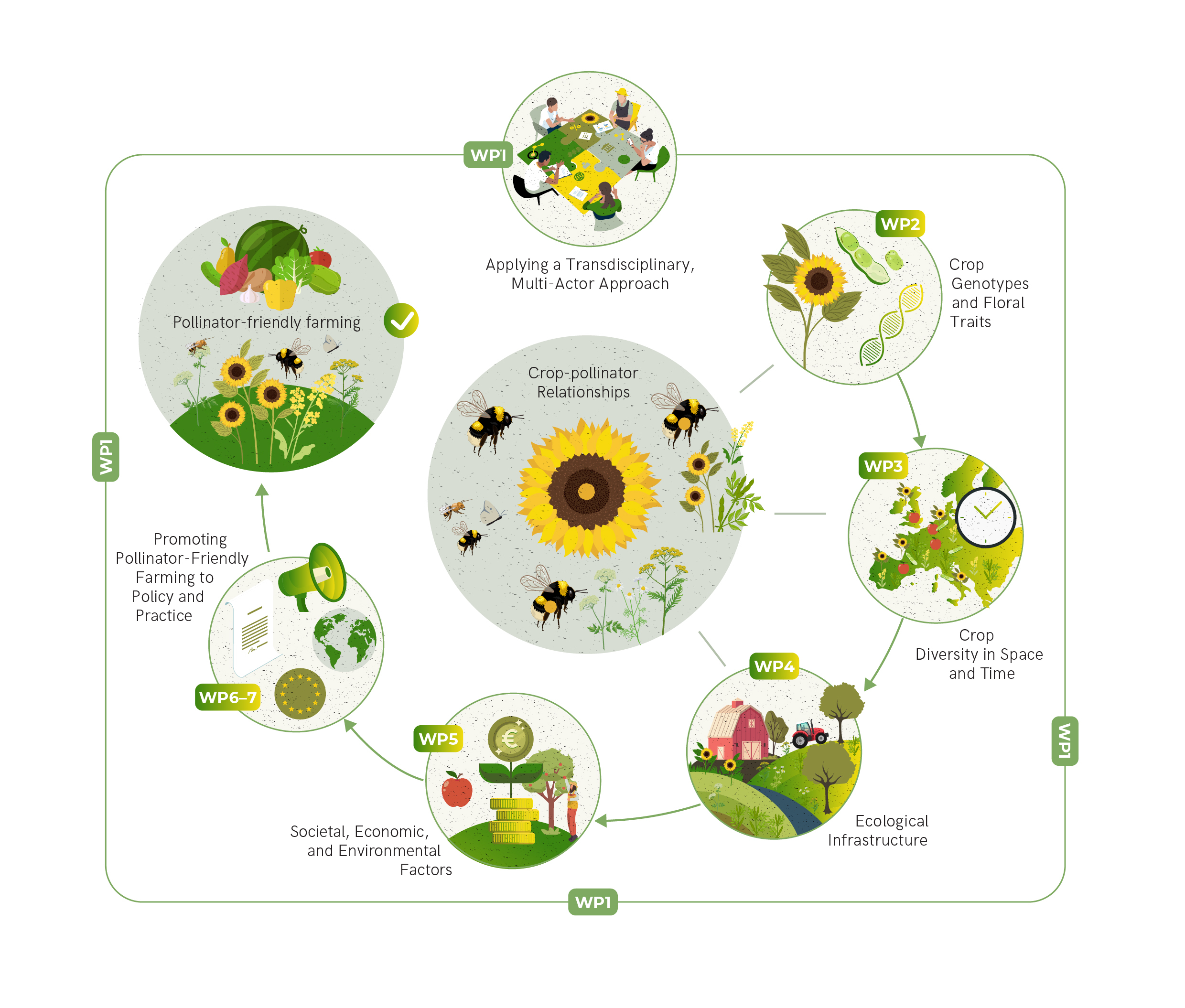
To achieve its goals, AGRI4POL project has outlined seven objectives:
- Work with a multi-actor community on research and solutions for promoting pollinator-friendly farming,
- Evaluate crop genetics, varieties and floral traits governing pollinator attraction, to stimulate breeding of future pollinator-smart crops,
- Establish the benefits of pollinator-friendly farming systems for farmers and farming,
- Optimise ecological and landscape features for crop pollination, pollinator biodiversity and multiple ecosystem benefits,
- Assess the social and economic opportunities and obstacles presented by pollinator friendly farming options,
- Evaluate how policies and practitioner awareness influence uptake of pollinator-friendly farming from national to international scales,
- Communicate and promote the benefits of pollinator-friendly farming.
Co-benefits and trade-offs associated with pollinator-friendly farming solutions
When pollinator-friendly farming measures and practices are implemented, they often come with certain co-benefits or trade-offs. At CzechGlobe, our work in this project focuses on identifying and assessing these additional positive and negative outcomes which extend beyond pollination support. The positive outcomes, co-benefits, can be environmental, agronomic, economic, or social, contributing to broader agricultural sustainability. Some of them may come from broader policy goals that agricultural systems are embedded within.
Trade-offs, on the other hand, are the negative outcomes (again, extending beyond the positive impact of pollination support) of this implementation. A practice may contribute to long-term sustainability and pollination services, but it may also present short-term negative impacts that require adjustments in farm management. Understanding these trade-offs is essential so that we can ensure that pollinator-friendly farming remains beneficial for farmers and contributes to the broader social and policy context. Knowing this, we make sure to explore these negative outcomes as well.
How do we do this?
The partners involved in WP1 are currently preparing for the first European-level stakeholder workshop in Brussels. This event should serve as a catalyst for the whole project and should also primarily contribute to its first objective. We will be speaking about co-benefits and trade-offs with EU-level stakeholders from farming organisations and areas of policy.
Following this key workshop, we plan to conduct (sub-)national focus groups in five European countries (including Czechia) led by five project partners (including CzechGlobe) to explore how understandings of co-benefits and trade-offs differ across these different contexts. And finally, we will complement this with stakeholder interviews in all five countries in combination with an analysis of sub-national policy and management plans. This combined approach will help us understand how the processes of implementation of pollinator-friendly farming address barriers, deliver co-benefits and minimise trade-offs.
Authors: Simona Zvěřinová, Tereza Prášilová and Julia Leventon. Some text sourced from this press release.

AGRI4POL receives funding from the European Union’s Horizon Europe research and innovation programmeunder grant agreement No 101181146 and The State Secretariat for Education, Research and Innovation (SERI). Views and opinions expressed are those of the author(s) only and do not necessarily reflect those of the European Union (EU), the European Research Executive Agency (REA), or the SERI.







 SustainableCZ