
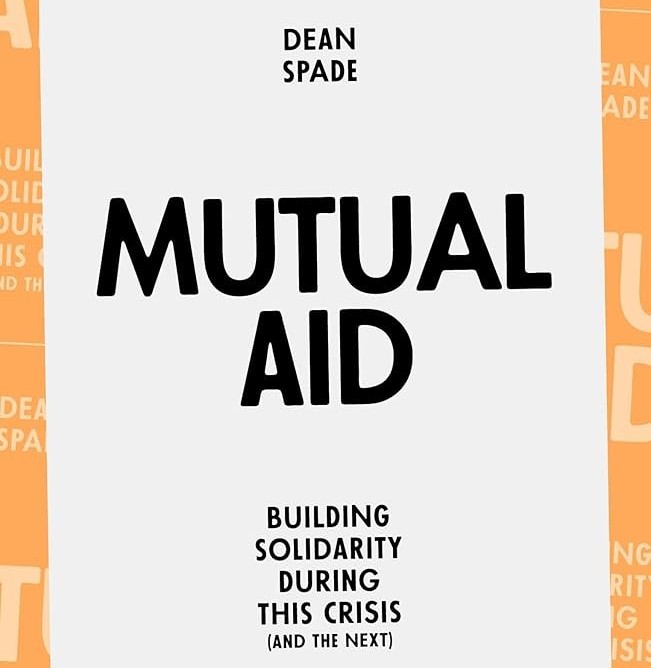
This summary review presents Dean Spade’s book, “Mutual Aid: Building Solidarity During This Crisis (and the Next),” published by Verso Press in October 2020. Five years after its release, the book remains highly relevant to contemporary politics.
Spade aims to illustrate how a sense of emergency determines contemporary politics arising from severe crises such as the COVID-19 pandemic, environmental problems, gender-based violence, racial discrimination, and wealth inequality. In response, more people are forming alternative solidarity-based collectives within their communities to support and care for one another. Spade defines this collective coordination of people as mutual aid, emphasising its significance and best practices for implementation in his book.
The book distinguishes mutual aid from charities, which all too often exist to improve the image of the rich or elites rather than to address systemic inequalities. As a result, charity can create a distinction between the “deserving” and “undeserving” poor—one that is often shaped by racial and gender norms. These norms include stereotypes suggesting that women of color and immigrant women are poor because they have too many children, or that Indigenous children are better off separated from their families in order to be assimilated into the dominant culture. However, more importantly, charity does not challenge the concentration of wealth and power—it operates within it. In many cases, charity treats poverty as a personal failing rather than the result of deeply rooted structural injustices.
A brief parenthetical note here: mutual aid is not a new concept; it has a long history of practice. The Black Panthers, for instance, implemented various “survival programs” aimed at developing and supplementing the social services that the state should have provided to underserved Black communities in the United States in the second half of the 20th century. These programs included free health clinics, breakfasts for school children, employment and workforce development, and legal aid. More recently established mutual aid networks served as a response to natural disasters like Hurricane Katrina and pandemics such as COVID-19. These networks operated to ensure that neighbourhoods maintain a strong social infrastructure, enabling them to respond effectively to acute crises and work toward a just transition for long-term rebuilding efforts.
A practical guide for mutual aid groups
The book’s primary purpose is to act as a practical guide for forming mutual aid groups and networks. It addresses a wide range of practical concerns by providing detailed answers to questions that these groups often encounter. Topics include strategies for effective teamwork, collaborative decision-making, and methods for preventing and resolving conflicts among group members. Regarding decision-making mechanisms, for instance, all members must feel involved in decision-making in the mutual aid groups. Spade advocates for consensus decision-making, ensuring all voices are heard, fostering engagement and collaboration rather than competition. Unlike majority-rule systems, consensus encourages valuing diverse perspectives and leads to stronger, more inclusive decisions. The process begins with the development of a proposal, during which the group collaborates to refine an idea until there is a general consensus among most members. Once the proposal is shaped, a consensus check takes place, allowing individuals to voice any concerns through what are known as “stand asides,” which signify disagreement without obstructing the process or by raising “blocks” if they feel that changes are necessary to move forward. After addressing these concerns, the group revisits the proposal, making any needed revisions before arriving at a final decision.
Another question of practicality he examines is: “How do we imagine ‘scaling up’ mutual aid to a point where everyone has what they need, and gets to meaningfully co-govern and co-steward the structures and conditions of their lives?” Scaling up in the book does not mean making groups bigger or unifying them into one organization across a region or country. Spade argues that locally operated mutual aid works better for meeting people’s needs and that those best meet these needs with the most local knowledge. In this sense, scaling up mutual aid means “building more and more mutual aid groups, copying each other’s best practices, and adapting them to work for particular neighborhoods, subcultures, and enclaves.”
The book is divided into three parts. Part 1 explains the three key elements of mutual aid, distinguishes it from charity and federal relief agencies, and highlights the realities faced by those on the frontlines of mutual aid efforts. Part 2 serves as a practical guide for building sustainable mutual aid networks. “No Masters No Flakes” is the most practical chapter in this sense, analysing how good personal and collective practices can be built within mutual aid groups. Some charts and lists in this chapter can prove useful for group meetings to encourage conversations and build shared group practices. Part 3 basically addresses the pitfalls that mutual aid movements should avoid.
In short, Spade renders a useful introduction and guide to mutual aid work within this book. To some extent, mutual aid is seen as a beacon of hope for society, in Spade’s own words, “where we share everything, co-govern everything, have everything we need and don’t rely on coercion and domination.” On the other hand, the long-term survival of these groups is a key challenge that warrants discussion.
📚 Spade, Dean. 2020. Mutual Aid: Building Solidarity During This Crisis (and the Next). Verso.








 SustainableCZ
Leave a comment