
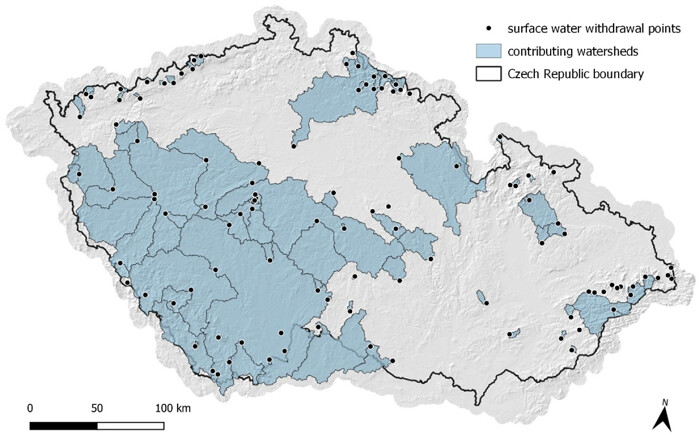
Ensuring affordable access to safe drinking water is a key sustainability and governance challenge. A new Czech study examines how land cover and watershed characteristics relate to drinking water treatment costs, offering evidence that can inform long-term water and land-use policy.
Using data from surface-water utilities, the researchers found that larger systems tend to operate more efficiently, with lower average costs per unit of water. This highlights the importance of institutional cooperation, shared infrastructure, and regional planning—especially for small or fragmented water providers.
The study also shows that larger watersheds are linked to higher treatment costs, likely due to their greater complexity and diversity of land uses. For policymakers, this underlines the need to account for landscape-scale characteristics when planning water investments and setting tariffs.
Interestingly, the analysis did not find strong evidence that higher forest cover automatically leads to lower treatment costs. While forests provide many environmental benefits, their influence on treatment expenditures appears to be context-dependent and not guaranteed. This finding cautions against relying on simple assumptions when promoting nature-based solutions.
Overall, the study reinforces a key message for sustainable governance: land management, infrastructure planning, and water policy must be designed together. Evidence-based approaches are essential to ensure that environmental goals and economic realities are aligned.
Horváthová, E., Mácová, K., Krpec, P. (2025) Estimating the Effect of Land Cover on Water Treatment Costs: Evidence from the Czech Republic”. Water Economics and Policy, 2550012. https://doi.org/10.1142/S2382624X25500122.










 SustainableCZ
Leave a comment