
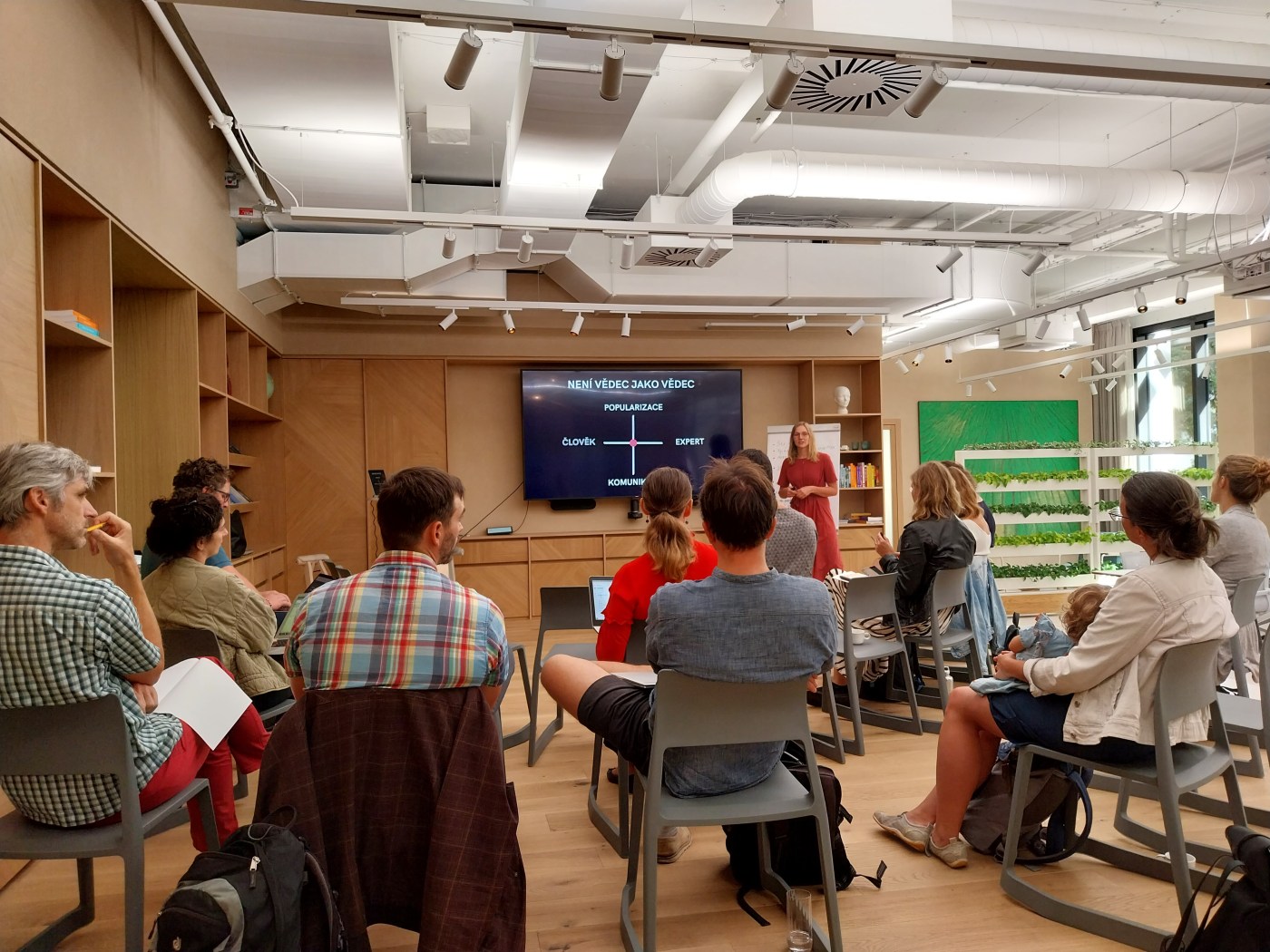
At the beginning of October, Pavlína Schultzová, Lenka Suchá, and Zuzana Harmáčková from the Department of Social-Ecological Analysis participated in a workshop dedicated to Climate Science Communication organized by People in Need as part of the European Climate Foundation (ECF) project. This workshop brought together both scientists and journalists who specialize in communicating and popularizing environmental issues, particularly climate change. It was a unique opportunity to discuss barriers in the cooperation between scientists and journalists and how to overcome them. The participants also received useful tips on how to communicate science clearly and comprehensibly. In the blog post below, we provide a summary of the workshop’s most interesting highlights.
Science communication represents an integral part of the work of a scientist. Unfortunately, many scientists do not realize its importance and the potential impact well-done popularization of scientific topics can have on society. This goes hand in hand with the fact that many scientists do not have proper knowledge of the opportunities that science communication provides, along with the myriad of communication formats a scientist can experiment with.
What are the main barriers to science communication?
There are many barriers and obstacles that hinder effective cooperation between scientists and journalists, one of the most crucial ones being insufficient communication training (and quite often no training) of scientists. This consequently leads to the frequent use of scientific language in articles or other types of media outputs that are extremely incomprehensible for the wider (non-scientific) audience. Also, due to the nature of research papers, which scientists are trained to produce, it is very difficult for them to highlight the most important and interesting things from their research, eventually leading to seemingly “uninteresting” articles in the media.
Apart from that, especially in the Czech context, there is a prevalent disinterest in science communication from scientists. Much of this disinterest stems from the lack of motivation to focus on this component of scientific work. Although highly beneficial for society, communicating scientific results, discoveries and other important knowledge to the public is not sufficiently rewarded by academia (especially in the Czech Republic). The success of scientists is usually evaluated by the number and quality of published papers in peer-reviewed journals rather than by involvement in the popularization of science.
Another reason for this disinterest is that, quite often, scientists’ fear of and discomfort with public appearances and public speaking. This is partly due to the aforementioned lack of communication training. Nevertheless, the fear of media presence is often not fully unwarranted, especially when it comes to commenting on things outside of a researcher’s own expertise. Stating inaccurate or false information could possibly backfire, resulting in the discredit of either the issue or the researcher’s reputation – both very undesirable consequences in academia. However, researchers sometimes feel the need to comment on anything and everything when they are approached, since the media frequently refer to the same experts while others get no media attention at all.
What are the possible solutions to overcome these barriers?
Obviously, there is no simple solution to the obstacles mentioned above. However, there are some strategies and tips on how to cope with them. What follows is some general advice for scientists on how to proceed when contacted by a journalist which can alleviate some public speaking concerns:
- You should always react to the inquiry (for the sake of beneficial scientific communication);
- Ask about the media format, specific topic, or anything that is unclear;
- Ask for questions ahead of an interview (even though interviewers can digress from them);
- Think through the main points that should be definitely mentioned;
- Practice public speaking (probably the most crucial advice);
- Ask for authorization (ask for the article draft to give approval before publication);
- You should not give comments or statements on topics out of your expertise (risks linked to this are mentioned above);
- Lastly, one should not be afraid to say “I don’t know” to a question if that truly is the answer.
Additionally, it is essential that journalists step out of their comfort zones as well and try to contact scientists or experts other than those that they usually approach. With that said, finding and recognizing relevant experts in a certain scientific field can be a challenging task for any journalist. If they have no prior experience with the research area, it is useful to contact a specific research/academic institution to receive a recommendation or look through expert databases, forums, or social media dedicated to connecting scientists and the public (e.g., Zeptej se vědce in the Czech Republic).
Lastly, scientists should always keep in mind that when presenting scientific research and its key results to the general public, it is crucial to make it as clear and comprehensible as possible. Luckily, there are some tools that scientists, along with journalists’ cooperation, can use to achieve this.
How do you make any scientific topic comprehensible?
It is imperative that you know your target audience – there are significant differences between writing an article for a scientific community and for readers of tabloid media. A useful tool to make this process easier is to imagine a specific future reader, characterize and define them, and then imagine explaining the topic to them. Also, this probably goes without saying, but you should always use clear comprehensible language and avoid scientific jargon, if possible. Unfortunately, there is a significant trade-off when it comes to science communication – on the one hand, scientists and journalists strive to educate the general public on the current burning global and societal issues, while propagating certain concepts and terminology that have to be understood and used in these contexts; on the other hand, journalists are pressured to write articles that are attractive and will increase the number of readers for the particular media, which requires the use of clear and comprehensible language.
As for the specific tools you can apply to make a difficult topic more relatable and comprehensible, analogies and metaphors are always recommended – if people are provided with an illustrative example of how a concept is related to something familiar, the likeliness of understanding the topic will increase dramatically. Storytelling is also very useful since people tend to follow storylines more easily than other formats – in other words, it is efficient to use a storytelling structure, including the main character (e.g., the scientist), the plot (e.g., the scientific problem), and the climax (e.g., the scientific solution). Also, the topic itself should be somehow relevant, especially to people’s needs, applicable in real life, and it should offer solutions to the presented issue at the same time. Moreover, any kind of visualization (e.g., graphs, diagrams) is very effective and always highly recommended when it comes to explaining more elaborate topics. Apart from graphs, there are also websites that provide illustrative pictures and photographs that anyone can use to accompany their article or presentation (e.g., Climate Visuals).
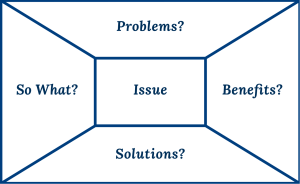
The last key suggestion is to think through the main message you would like the reader to fully understand and, ideally, remember. An extremely helpful tool is, for example, The Message Box (see Fig. 1). The procedure is as follows:
- Define your target audience.
- Put the topic into context.
- Why is the topic important?
- What are the possible solutions?
- Who will benefit from solving the problem?
To summarize, communicating climate science is fundamentally important in light of the current climate crisis, and workshops like the one described here are a hopeful sign that scientists and journalists are determined to establish a solid foundation for cooperation to overcome the aforementioned communication obstacles and advance climate science communication in the Czech Republic.
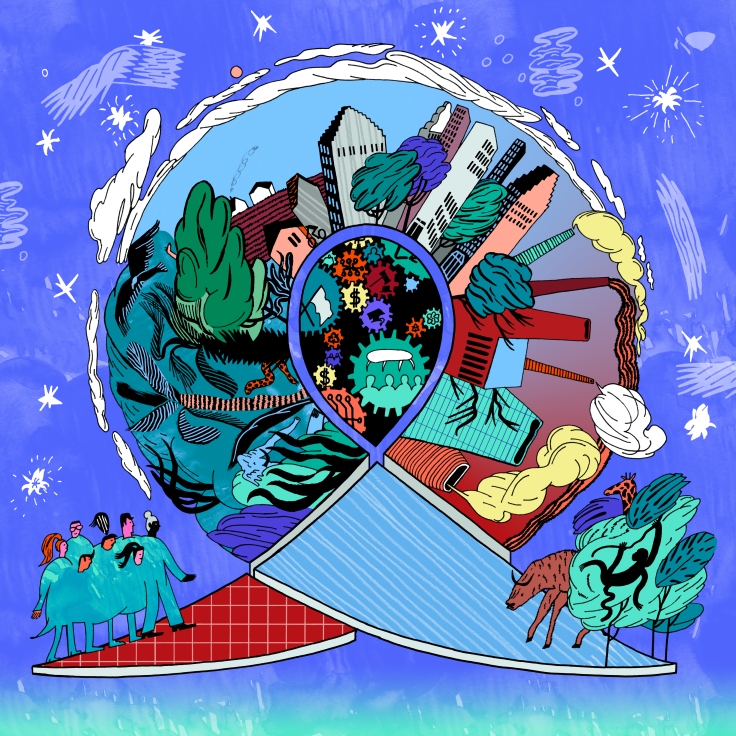
© Featured image by People in Need.







 SustainableCZ
Leave a comment