
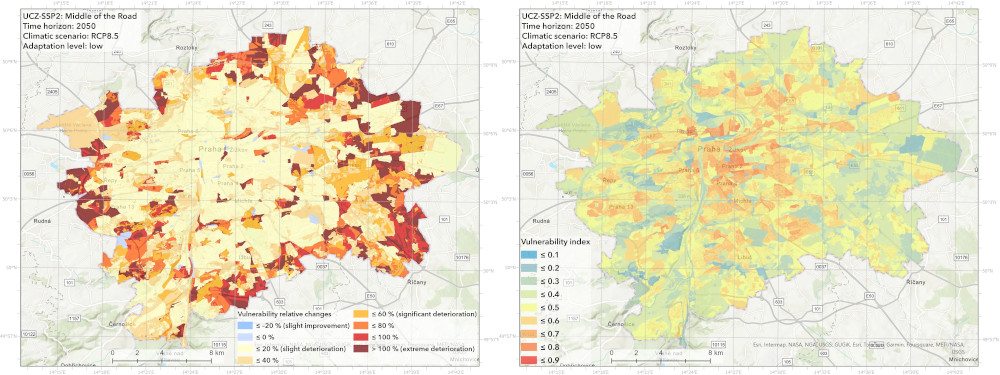
In 2022, Czech Globe in cooperation with the Institute of Informatics of the CAS completed the project “Adaptation challenges of cities: supporting sustainable planning using integrated vulnerability analysis”, supported by the Technology Agency of the Czech Republic. The project has developed an integrated methodology for assessing the vulnerability to future temperature extremes in cities, which was also certified by the Ministry of the Environment of the Czech Republic.
The proposed methodology generates future scenarios based on combinations of different components. The first component is urban climate models using Representative Concentration Pathways (RCPs), which describe future greenhouse gas concentrations based on increasing or decreasing carbon dioxide emissions. The second component includes stakeholder co-produced land use and land cover scenarios – see Suchá et al. (2022) for details – based on Shared Socioeconomic Pathways (SSPs) that examine how global society, demographics, and economies might change over the next century. Both SSP and RCP are adopted by IPCC models, with the most recent findings reported under the Sixth Assessment Report in 2021. The third component is based on demographic scenarios. Finally, heat vulnerability analysis facilitates data integration into spatially explicit scenarios.
Since the end of the project, we have been working on the final publication in the series, which demonstrates the methodology using the city of Prague as an example. The preprint article From scenarios to strategies. A methodology addressing urban heat vulnerability in uncertain future is now out to highlight methodological contributions and useful information for urban adaptation planning.
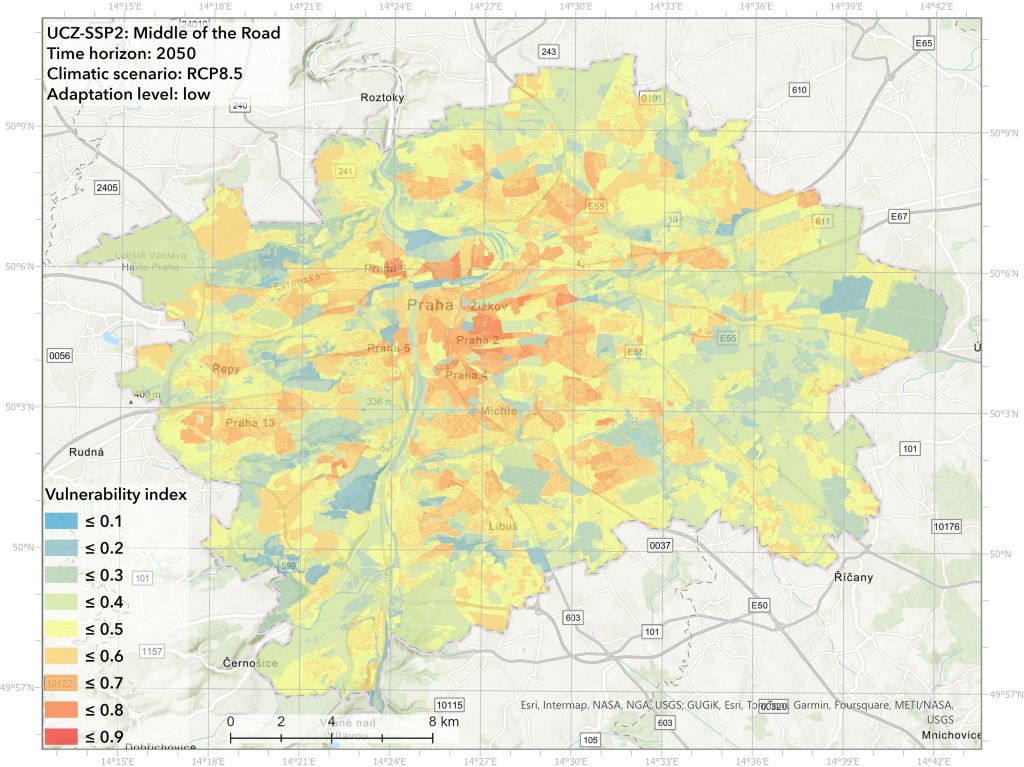

The resulting scenarios illustrate how a city’s heat vulnerability may evolve over time in response to changing climate, population, and urban development. Based on the results, we emphasise that ongoing climate impacts and current urbanisation trends are increasing the heat vulnerability. This is indeed a challenge for planners and decision-makers, as more people and larger areas of cities will be increasingly vulnerable to higher temperatures. The negative impacts on health and well-being cannot be overlooked.
However, we also shed light on how nature-based solutions can effectively reduce heat vulnerability when applied at scale, and on the differentiated effects of such adaptation across specific urban areas, from residential neighbourhoods in the urban core to brownfields and future districts on city’s periphery. We believe this study provides important insights for planning climate resilient and sustainable cities.









 SustainableCZ
Leave a comment