

In June 2025, the ISEE-Degrowth Conference took place in Oslo under the theme “Building socially just postgrowth futures – linking theory and action.” This unique event combined the 18th International Society for Ecological Economics (ISEE) Conference and the 11th International Degrowth Conference, drawing over 1,200 participants from 60 countries, supported by approximately 70 volunteers.
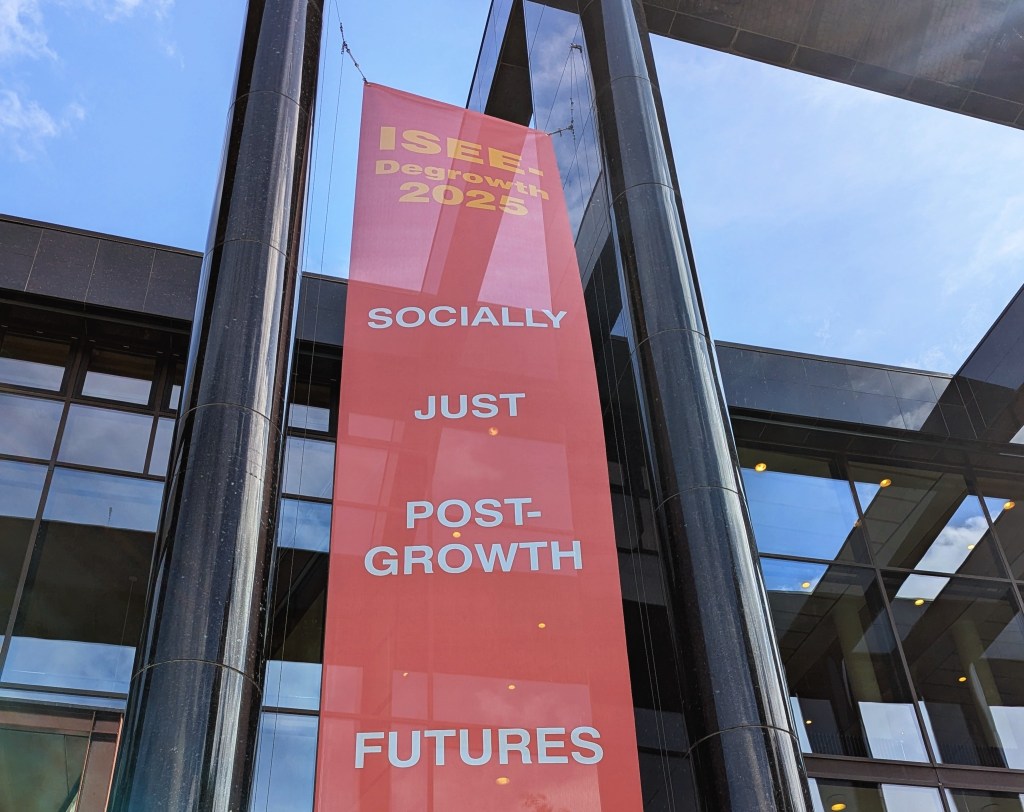
The conference served as a platform for critical discussions on ecological economics and degrowth, while also fostering an open, activist-oriented environment aimed at creating real-world impact. Organisers, indeed, worked to ensure that conversations extended beyond the confines of academia, involving policymakers, NGOs, activists, and local communities. The “Beyond the Conference” initiatives, for instance, brought theory into everyday practice through events and creative exchanges. These activities were accessible not just to conference attendees but also to the general public.
One highlight was the Degrowth Cabaret, organised in collaboration with Karmaklubb and the queer community — a compelling blend of performance, politics, and social commentary that exemplified the inclusive and experimental spirit of the event.
A glimpse of what a truly sustainability-focused conference can look like
Sustainability was central not only in content but in practice: all meals were vegan, prepared with organic, fairtrade, and locally sourced ingredients. Participants were encouraged to bring reusable coffee cups, and it was inspiring to see that several attendees chose train travel — often involving long and complex routes — as a way to reduce their environmental footprint. Many plenary sessions were livestreamed, and select sessions were offered in hybrid formats, allowing broader participation without registration fees.
Among the presenters was Elif Tuğba Şimşek, representing CzechGlobe, who delivered a talk titled “Transformations for Socially and Environmentally Just Futures.” Her presentation was part of session RS 1.1.7: Social, Intergenerational, and Environmental Justice, and built on research initiated during a Short-Term Scientific Mission (STSM) at the Science and Research Centre in Koper, Slovenia, in October 2024. The study is supported by the COST Action TransformERS (CA22156).
Şimşek shared early findings from a scoping literature review that explores how the concept of the “future” is framed in transformation studies. The work examines how scholars conceptualise fair and sustainable futures, what tools and methods they propose, and how they address the issue of plurality — specifically, who is included in imagining and shaping these futures. The presentation was part of a broader effort to develop collaborative frameworks and share preliminary results with academic and practitioner audiences. A publication based on the study is currently in progress.
The ISEE-Degrowth 2025 Conference, in the end, demonstrated that the pursuit of socially and environmentally just futures is not only a theoretical endeavour, but a lived, collective process — grounded in collaboration, creativity, and real action.








 SustainableCZ
Leave a comment