

How can big systemic ideas support people who are working on biodiversity challenges in their everyday practice? In our recent study from the PLANET4B project (🔗), we explored what happens when a well-known concept from systems thinking – the leverage points framework – is brought into participatory workshops with diverse stakeholders. Rather than debating the theory itself, we asked a more grounded question: Is it useful in practice, for whom, and under what conditions? The article has now been published in the International Journal of the Commons (🔗) and builds on the experiences of colleagues who facilitated learning processes in five European case studies as a part of the Horizon Europe PLANET4B project.
From concept to conversation
The idea of leverage points, introduced by Donella Meadows in 1999, proposes that in every complex system there are places where relatively small interventions can trigger large shifts. Some of these intervention points are visible and concrete – for instance, changing funding schemes or regulations. Others are deeper and harder to influence, such as societal goals, values or dominant narratives about nature. In sustainability science, there is growing agreement that without engaging these deeper dimensions, transformative change will remain limited. Yet moving from this insight to real conversations among stakeholders is far from simple.
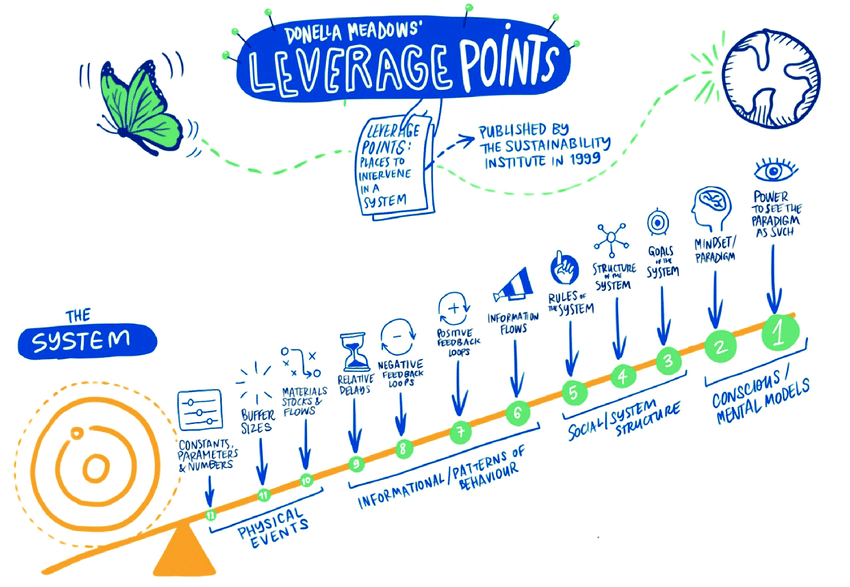
Fig. Donella Meadows’ leverage points (Source: based on Meadows, 1999; credit: UNDP/Carlotta Cataldi)
Working with learning communities across Europe
Within the PLANET4B project, researchers collaborated with learning communities in five different contexts:
- improving access to nature for socially excluded groups in Oslo,
- strengthening engagement of Black, Asian and ethnic minority communities with biodiversity issues in the United Kingdom,
- empowering young people with migration backgrounds to engage in biodiversity-related decision making in Germany,
- exploring links between religion and agro-biodiversity in Switzerland,
- and developing participatory edible-city initiatives in Graz.
Participants ranged from youth and NGOs to clergy, policy actors and residents – people with very different experiences and expectations. In the workshops in each case, facilitators explicitly introduced the leverage points idea and invited groups to map their case study systems and think about where change might be possible. To understand what this looked like in practice, we asked the case study leaders (facilitators of workshops) to reflect on their experiences. Their observations form the core of the research paper.
What worked well
Many facilitators saw real benefits of the framework. It helped structure complicated discussions and made relationships between everyday actions and broader dynamics more visible. Several case leads felt that the framework created space for multiple perspectives to surface and be discussed in relation to each other. As one facilitator summed up: “When explained carefully and multiple times to diverse young people, the framework helped to bring in different viewpoints.”
The visual nature of the exercise was often mentioned as helpful. Having a shared picture of the system made conversations easier to follow and gave participants something concrete to react to. However, successful moments rarely happened by accident. Trust-building, previous meetings and ice-breaker activities played a major role. One leader described how investing in relationships early on paid off later: “During the first meeting we did a lot of getting-to-know-each-other games … the members of the group were comfortable to speak, and this helped to create a safe space.” Where such conditions were present, participants were more willing to express uncertainty, challenge each other and explore new ideas.
The challenges of applying theory
The reflections also revealed difficulties that will sound familiar to many researchers. Academic language was a frequent obstacle. Facilitators had to continuously translate concepts into terms that resonated locally. One comment captured the tension very precisely: “Some participants couldn’t see why we presented it in the workshop and felt it was too academic. One felt it was a waste of time.” Time limitations were another issue. Understanding systems, feedbacks and deeper intentions simply takes longer than a standard session allows. In online settings, additional complications appeared. As one leader summarised: “It allowed different viewpoints, but clarification took away some time.” Some facilitators reflected critically on whether introducing the framework at the start might unintentionally shape the conversation too strongly. Instead, they suggested, participants could first articulate their experiences in their own language, with researchers later analysing them through the leverage points perspective. Interestingly, several leaders concluded that even if not every element of the framework fits perfectly, the learning journey itself remains valuable: “Whether we always manage to squeeze every aspect of the leverage points into our case seems less important than the learning process itself.”
Key take-home messages
- No framework replaces good facilitation: The leverage points approach can broaden perspectives and reveal hidden connections, but only when embedded in trustful relationships, flexibility and careful communication.
- Systems tools need translation: Concepts that are clear in academic debates often require rephrasing, examples and repetition to become meaningful in community settings.
- Inclusion is created by the process: Safe spaces, trust and active facilitation are what enable diverse voices to contribute.
- Depth takes time: Moving from “quick fixes” to underlying values and intentions cannot be rushed.
- Learning may be more important than perfect categorisation: Even when the framework is not applied “by the book”, it can still stimulate reflection and new connections.
Why this matters for future projects
Participatory sustainability work often relies on strong conceptual tools. Our findings suggest that equal attention must be paid to how these tools are introduced, adapted and supported. Investing in facilitation skills, translation into everyday language and realistic expectations about time can significantly influence outcomes. By sharing these grounded experiences – including doubts and moments of friction – we hope to support others who try to bridge systems thinking and real-world practice.
You can read the full open-access article here: Loučková et al. (2026). Exploring the Practical Application of Leverage Points Framework for Transformative Interventions for Biodiversity









 SustainableCZ
Leave a comment