
Engaging stakeholders is essential: The coproduction of knowledge and transdisciplinary approaches are suggested as promising means to deliver relevant, credible, and legitimate outcomes to increase the impact of ecosystem services assessments. On a national level, consultations with key actors can help address the gap between ecosystem services knowledge and its implementation policy, decision-making, and practice.
A new open access paper in Ecosystem Services introduces a unique stakeholder engagement approach in ecosystem services research and implementation. We employed a stakeholder consultation process which aimed to tailor the forthcoming ecosystem services assessment to the needs of target users and to facilitate the establishment of a national science-policy interface.
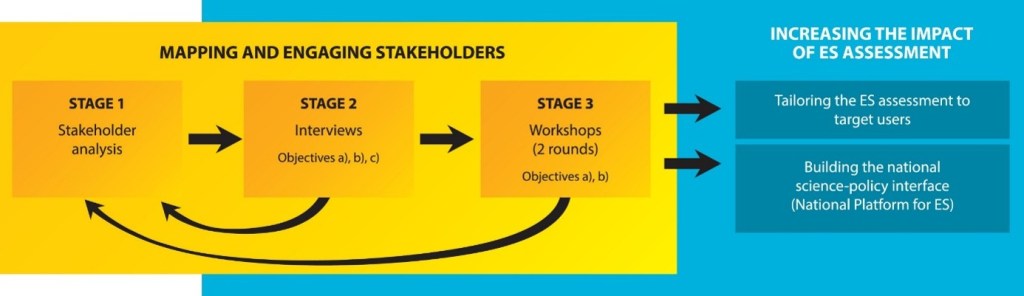
Workflow diagram of each method and their relationship within the process of consultations with stakeholders (blue box) which served following objectives by identifying: a) stakeholder’s attitudes towards ES (priorities, needs, knowledge, and experiences with ES); b) opportunities for implementation of the ES framework; c) inputs to design the NPES.
What we did
We used a multimethod approach, applying stakeholder analysis, semistructured interviews, and participatory workshops. We gathered empirical data on the purpose of ecosystem services assessments and the settings of the forthcoming national platform, following the ultimate goal to increase the impact of ecosystem services assessment. A three-dimensional stakeholder matrix allowed us to select the key stakeholders to be involved in various stages of consultations.
Key findings
Stakeholders prioritized ecosystem services for assessment, with the highest demand for regulating ecosystem services. They also highlighted perceived barriers, suitable areas for ecosystem services implementation, and factors influencing the uptake of the ecosystem services framework. Moreover, they provided specific examples of expected use and perceived barriers to use for the assessment of two ecosystem services: regulation of climate and physical and psychological experiences.
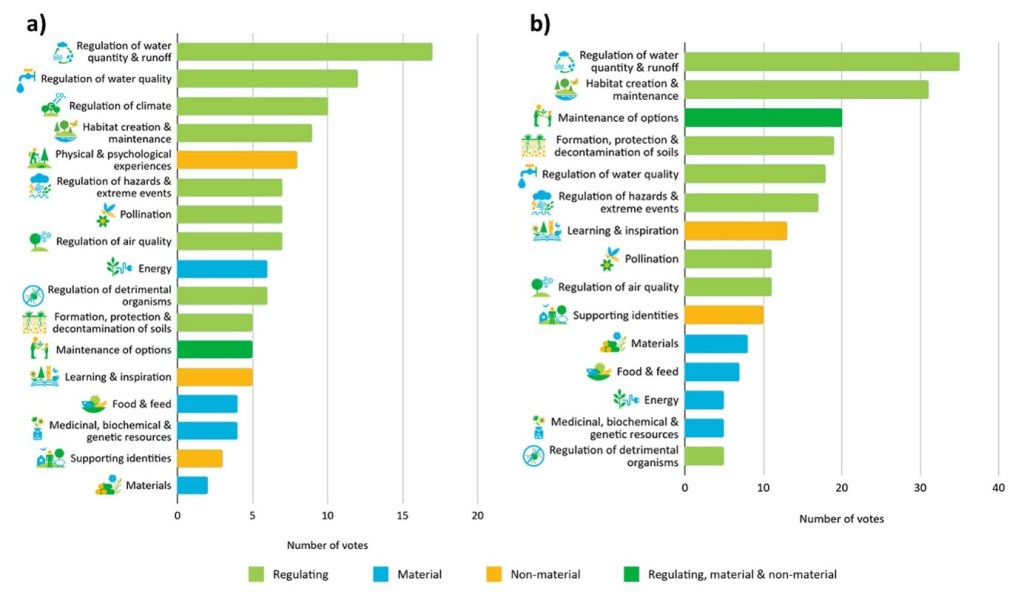
(a): Prioritization of ES for assessment in interviews. (b): Prioritization of ES for assessment in workshops.
Mapping and engaging stakeholders and the knowledge coproduced allowed to tailor the ecosystem services assessment to the needs of target users and facilitated the development of the National Platform for Ecosystem Services. We suggest that stakeholder consultations can help to address the gap between ecosystem services knowledge and its desirable application in policy, decision making, and practice.
Source: Daněk, J., Mácová, K., Farkač, B., Vačkářová, D., 2026. Tailoring ecosystem services assessment to target users and building a national platform: Stakeholder consultations case study in the Czech Republic. Ecosystem Services 79, 101854.
Full Length Article: https://doi.org/10.1016/j.ecoser.2026.101854

This project has received funding from the Integrated LIFE project for Natura 2000 in the Czech Republic, LIFE-IP: N2K Revisited (One Nature), LIFE17 IPE/CZ/000005.










Leave a Reply