

Engaging across disciplines and navigating between research and practise, is something we do a lot in our departments. No matter how much we do it however, it never ceases to be inspiring and incredibly eye-opening! I (Charlie Whitham) was very excited therefore, to be invited to deliver a seminar at the Faculty of Social Sciences at the University of Applied Sciences, Koblenz, Germany, as part of their International Week in June 2026 – an annual week of talks, workshops and discussions on a central theme, where students from a wide range of disciplines/diploma courses, have the opportunity to step a little outside of their normal timetables, and to hear about research and practise from external experts and practitioners.
This year’s theme for the Faculty’s International Week was: “Transformative Societies: Respect, Diversity, Co-creation”. Building up to this, I had been collaborating with a researcher at Koblenz (Dr. Andy Schieler from the Institute of Early Childhood Education, Upbringing, and Care in Rhineland-Palatinate) on some work looking at the role of the Early Childhood Education and Care sector in transformative change. Andy spotted the overlap between some of this work, my research interests in general, and this year’s theme of the International Week…and invited me to participate.
My seminar was to be attended by the Social Work Diploma Programme students, which, given what was said at the beginning of this blog about “engaging across disciplines and navigating between research and practise”, I was very excited about!
Unfortunately, due to a very intense heatwave, fewer students were able to attend than originally planned, but in the end, roughly 15 very engaged individuals attended, armed with fans and bottles of water! I delivered a short presentation about human-nature relationships and connections, how they develop in early childhood and how supporting this might be important for transformative societies. In this way, we kept referring back to the theme of the event, but most importantly, throughout the talk and discussion space, I encouraged the students to think about all of this in relation to their work as social workers:
- Did they consider nature and our relationships with nature to be important for transformative societies?
- What did this all mean to them personally, in their families, communities, cultures and religions?
- Did they have a role personally or as social workers in the development of human-nature relationships, particularly for young children?
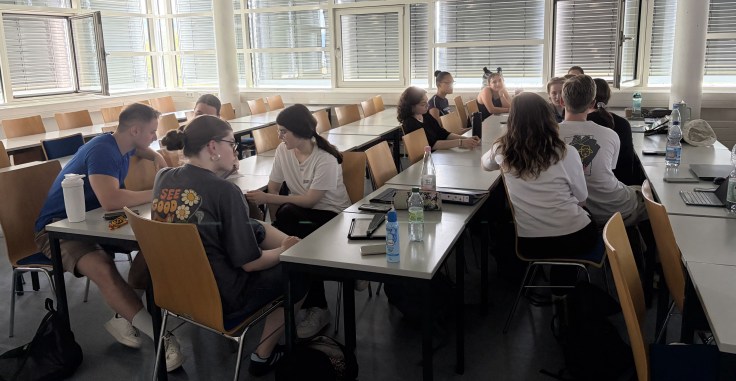
Taking this a bit further, we then enjoyed an interactive activity to help apply some of these ideas and concepts to the students’ professional lives. With some time for individual reflection, group discussions and scenario games, students were able to reflect on their own, personal relationship with nature and on the importance of values and their development. They could also explore how human-nature connection and its development in early childhood could be linked to many social work contexts. Most exciting with the scenario exercise, was that students could begin to identify practical ways they might support and nurture these human-nature values and relationships in young children.
For me, it was incredibly refreshing to look through another lens – this time, a lens of young in-training social workers in western Germany. For example, I learnt a little about the sort of social mechanisms in-place in the Rhineland-Palatinate that might have potential to support urban-based families’ connections with nature. The students raised issues about inter-generational learning and experience, and their own roles as social workers in the inclusion of children’s views into decision-making.
I hope that this seminar gave the students an opportunity to think about something perhaps not normally considered in their normal areas of work and study. On the other hand, the opinions, concerns and ideas shared by the seemingly very motivated students was also hugely beneficial to me – to help me better understand another form of practical application of the concepts and research with which I am engaged.
I am extremely grateful to the students for sharing their time, energy and ideas that hot afternoon! I would also like to thank the International Week organisers, especially Anja Sperber for helping get me to Koblenz and for such a warm welcome (literally with the heat, but also introducing me to other members of the Faculty and helping everything to flow smoothly!), and of course a huge thank you to my collaborator and friend Dr. Andy Schieler for the initial invitation.
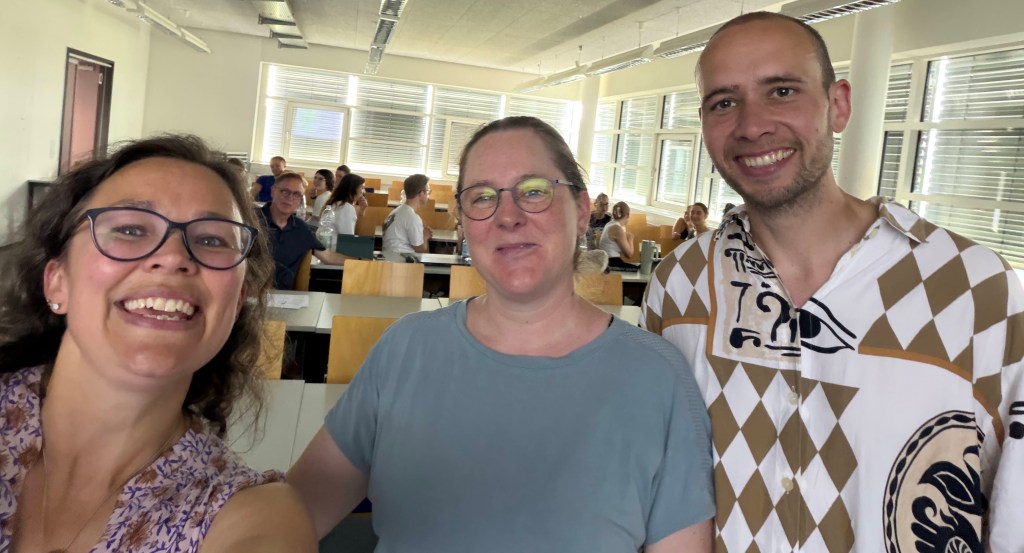
Looking back, this experience reaffirmed the importance of stepping beyond the boundaries of our own disciplines and engaging with research in real-world contexts. I hope there will be many more opportunities for CzechGlobe researchers to connect with practitioners, professionals and communities from across different sectors and contexts. When this happens, knowledge doesn’t simply travel in one direction—it grows through dialogue, creating new ideas, fresh perspectives and stronger foundations for the transformative change we all hope to see and practise.







Leave a Reply