
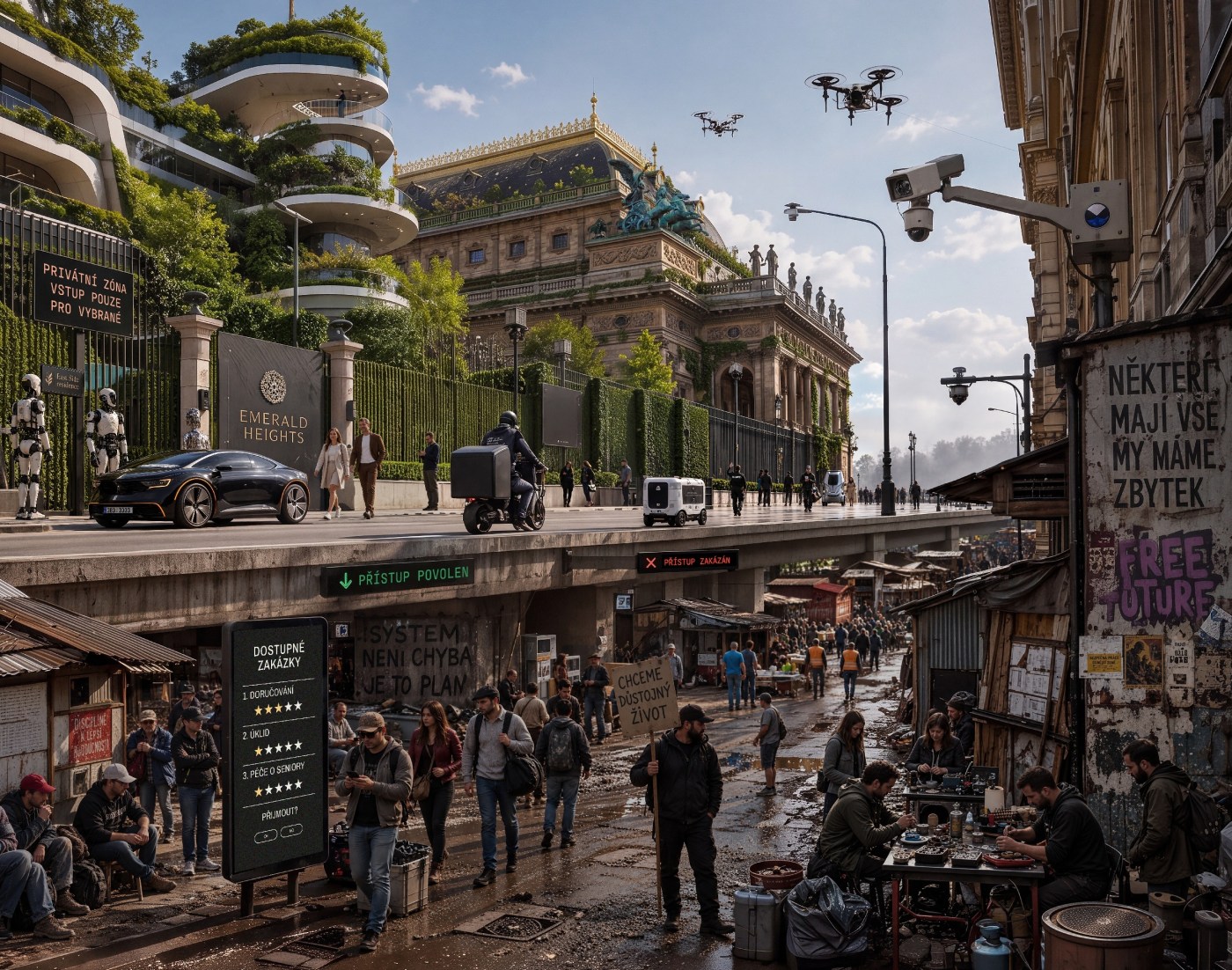
What might Czechia look like several decades from now? Will we live in a society built around cooperation, trust and long-term planning? Could growing geopolitical tensions and social fragmentation reshape the way our institutions function? Will technological progress reduce inequalities or deepen them? And what happens if economic growth remains the dominant measure of societal success?
These questions are at the heart of a new report, Scenarios of Future Socioeconomic Development for the Czech Republic until 2100 (CZ-SSPs), published by the Social-Ecological Analysis Lab at Global Change Research Institute of the Czech Academy of Sciences – CzechGlobe.
Rather than predicting what the future will look like, the scenarios explore several contrasting ways in which Czech society could develop over the course of the 21st century. They are intended as a tool for researchers, public authorities and other organisations that need to make decisions today while facing considerable uncertainty about the decades ahead.
Four contrasting futures for Czechia
The CZ-SSPs build on the internationally established Shared Socioeconomic Pathways (SSPs) and their European adaptations, translating this global framework into the specific social, institutional, economic and environmental context of Czechia.
The resulting report presents four contrasting scenarios:
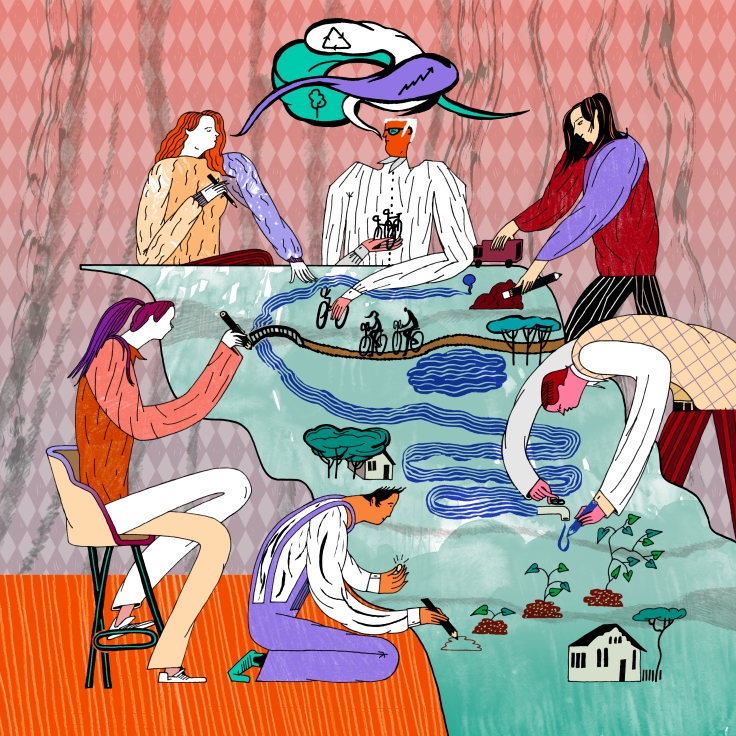
CZ-SSP1: Balance (Rovnováha) describes a society increasingly oriented towards quality of life, trust, cooperation and long-term planning, with technological development supporting public interests and environmental sustainability.
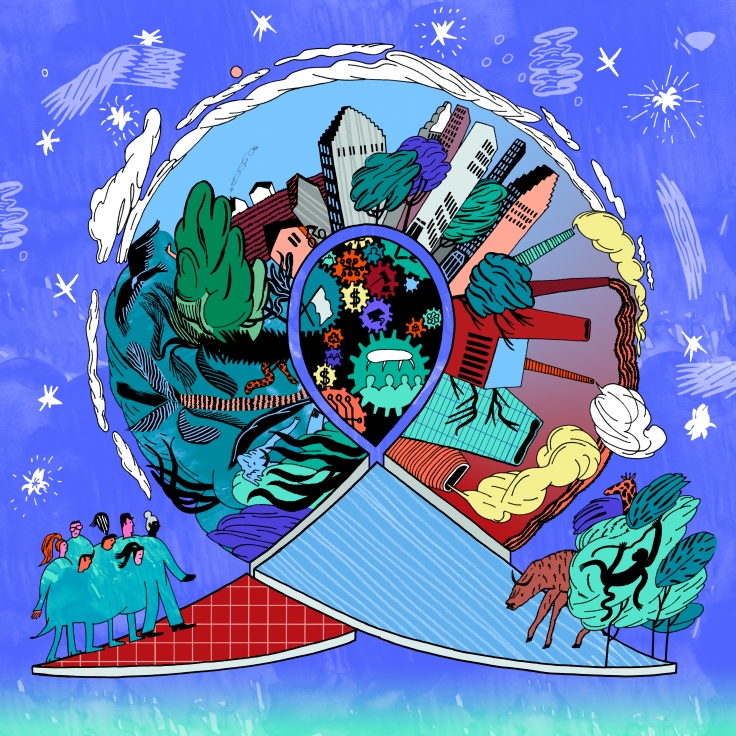
CZ-SSP3: Conflict and Breakdown (Konflikt a rozpad) explores a future characterised by weakening international cooperation, declining trust in institutions, increasing social fragmentation and growing pressure on natural resources.
CZ-SSP4: Fortified Worlds (Opevněné světy) depicts a technologically advanced but highly unequal society in which access to the benefits of technological and economic development becomes increasingly uneven.
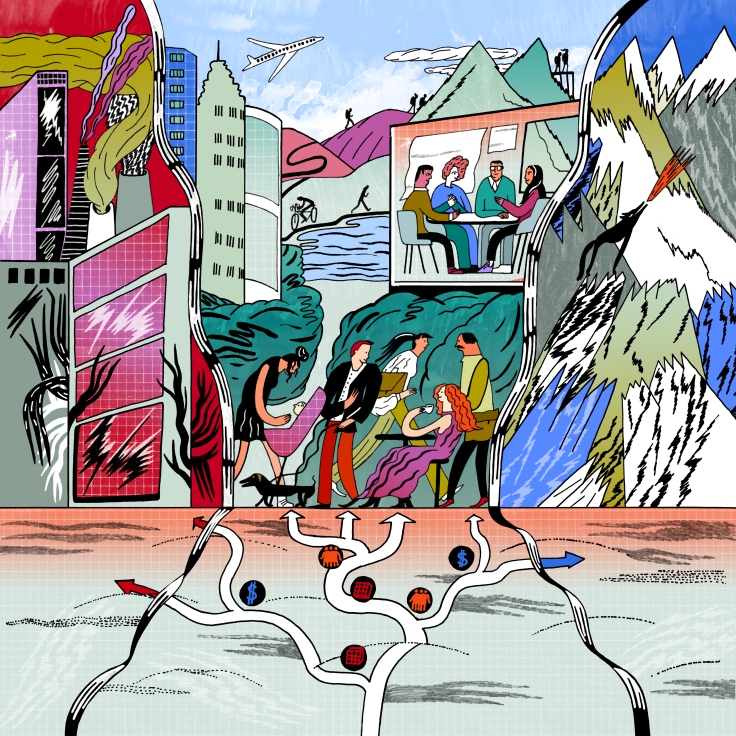
CZ-SSP5: All Faces of Growth (Všechny tváře růstu) explores a future in which economic growth and technological innovation remain dominant societal priorities, generating high levels of prosperity while simultaneously creating new environmental and social challenges.
The scenarios deliberately do not identify one future as the most desirable or most probable. Instead, they make different assumptions and dynamics visible and allow us to ask a more useful question: Would the strategies and policies we are designing today still work if the future developed differently from what we currently expect?
More than two years of research and co-design
Developing the scenarios was an extensive research and co-design process lasting more than two years. The work combined a systematic review of existing scenarios relevant to Czechia, horizon scanning for weak signals, and repeated discussion and revision with experts from academia and public administration.
Almost 100 experts contributed to the process, including representatives of ministries, the Office of the Government, regional authorities and other public institutions. This made it possible to combine an internationally established scenario framework with detailed knowledge of the Czech institutional and societal context.
Why scenarios matter for decision-making
Many decisions being made today will have consequences far beyond current political, investment or planning cycles. Climate adaptation, infrastructure, energy systems, agriculture, spatial planning, biodiversity conservation and the design of public institutions all require us to think across decades. Yet long-term strategies can easily become dependent on a single implicit image of the future.
Scenario thinking offers a different approach. Instead of asking which future is most likely, it explores several plausible futures and the uncertainties associated with them. Strategies, policies or research questions can then be examined across these different conditions.
The CZ-SSPs can therefore be used in strategic planning and policy development, adaptation strategies, research projects, education and participatory processes. They can also support the stress-testing of strategies: identifying decisions that remain robust across several futures, as well as assumptions that may make existing strategies vulnerable to unexpected change.
Alongside the main report, the project has published practical guidance on using scenarios in strategic planning, a sectoral extension for agriculture, and open databases of weak signals, scenarios and drivers developed during the research.
Join us at CZ-SSPs launch event:
Czechia 2050, a panel discussion on scenarios of our future
on 5 November 2026, 18:00
Czech Academy of Sciences, Národní 3, Prague – Room 206
Panellists: Lenka Suchá, Zora Hesová, Daniel Čermák.
Moderated by: Zuzana V. Harmáčková and Pavlína Louženská.
The discussion, held as part of Czech Academy of Sciences Week 2026, will open up the scenarios to a broader conversation about Czechia’s possible futures. The panel will consider which long-term developments may be particularly important for public policy and strategic planning, how institutions can work with uncertainty, and what scenario approaches can contribute to decisions whose consequences extend far beyond a single planning cycle.
Five Faces of Tomorrow: visualising Prague in 2050
The scenarios will also leave the pages of the report. During Czech Academy of Sciences Week 2026, visitors to the Academy’s building on Národní Street in Prague will be able to see the accompanying exhibition Five Faces of Tomorrow (Pět tváří zítřka).
The exhibition translates socioeconomic scenarios into five large-scale visualisations of the same location in central Prague in 2050, particularly the area surrounding the Czech Academy of Sciences and the National Theatre. By placing alternative futures side by side, it asks how mobility, climate adaptation, technology, public space, inequality and everyday life might look under very different social and institutional conditions.
The exhibition will be presented in the Czech Academy of Sciences building on Národní Street during Czech Academy of Sciences Week 2026.
Explore and use the scenarios
The CZ-SSPs are an open resource for further research and practical application. We welcome their use by researchers, public authorities, educators, civil society organisations and other actors working with long-term strategies and uncertainty.
Project page and accompanying resources (in Czech): CZ-SSP scenarios on SustainableCZ
Full report (in Czech): Scenarios of Future Socioeconomic Development for the Czech Republic until 2100 (PDF)
DOI / repository record: Zenodo record
If you are interested in using the scenarios in research, strategic planning or participatory work, or would like to discuss possible collaboration, contact the Social-Ecological Analysis Lab at SELab@czechglobe.cz.
The CZ-SSP scenarios and related outputs were developed within the AdAgriF project – Advanced Methods of Greenhouse Gas Emission Reduction and Sequestration in Agricultural and Forest Landscapes for Climate Change Mitigation (CZ.02.01.01/00/22_008/0004635), supported by the Ministry of Education, Youth and Sports through the Johannes Amos Comenius Programme.







Leave a Reply