Česká verze příspěvku zde.
At the end of March 2026, Pavlína Schultzová, a member of the Department of Social-Ecological Analysis (SE Lab) (🔗) of the Global Change Research Institute CAS – CzechGlobe (🔗), received a three-year grant from the Charles University Grant Agency (GA UK) to support her dissertation project on Food Systems Transformation in the Context of Central and Eastern Europe. Below, you can read about the project’s objectives, methods, and expected outcomes. At the bottom, you can also download a one-pager with the project summary.
The Need for Context-Specific Food Systems Transformation
Food is an essential component of our everyday lives. Yet today’s food systems are under growing pressure. They contribute significantly to greenhouse gas emissions, biodiversity loss, environmental degradation, and public health challenges, while also becoming increasingly vulnerable to climate change themselves. This newly funded project responds to that urgency by asking a crucial question: how can Czechia and the broader Central and Eastern European (CEE) region move toward food systems that are socially just, resilient, and sustainable?
Food systems transformation is often discussed at the European level, but the realities of the CEE region are still too often overlooked and underrepresented in decision-making processes. Policies are predominantly shaped by Western European experiences and assumptions that do not always fit the socio-economic, cultural, and historical contexts of the CEE countries, including Czechia. This mismatch can result in significant public pushback against food sustainability policies. In this context, the project aims to generate knowledge that is not only academically relevant but also useful for policy and the ongoing public debate.
Project’s Objectives
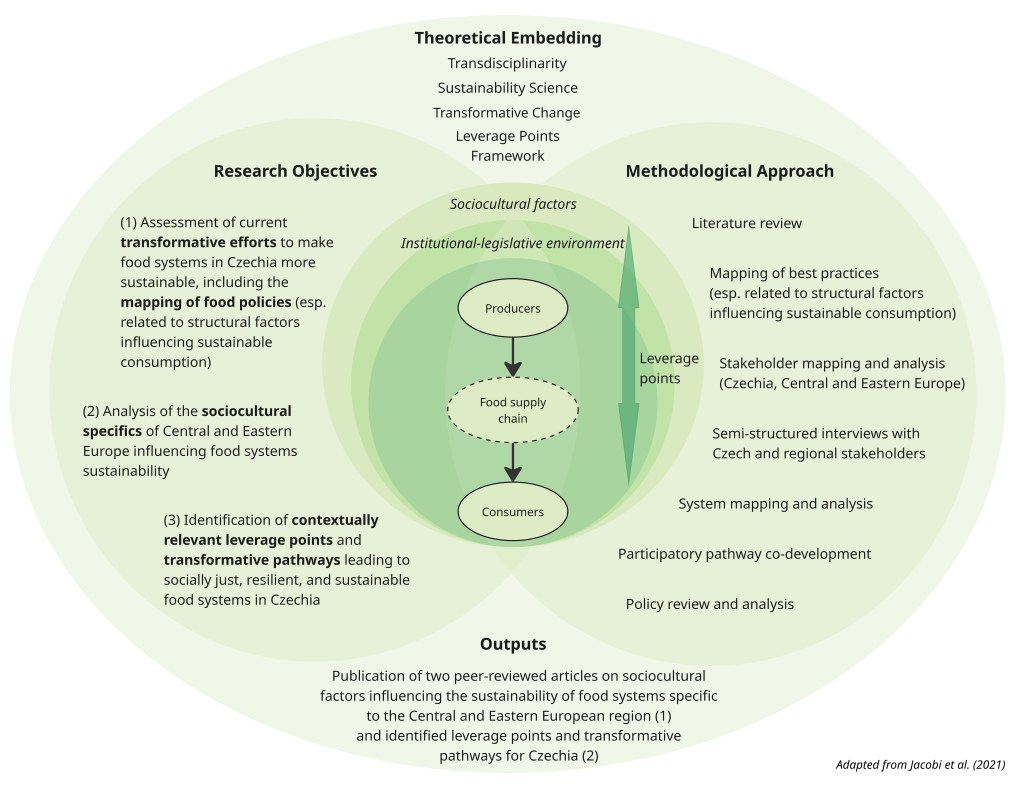
The project has three main objectives. First, it will assess current transformative efforts in Czechia to make food systems more sustainable, focusing on public-sector, non-governmental, citizen-led initiatives and change-makers. Second, it will explore the specific social and cultural factors that shape food systems transformation in CEE countries. Third, it will identify contextually relevant leverage points and transformative pathways that can help move Czechia toward fairer, more resilient, and more sustainable food systems.
A core focus of this project is on structural factors shaping the institutional environment, which determines the enabling conditions for sustainable consumption. By exploring these factors (particularly sociocultural ones), the project seeks to understand why the institutional environment in the CEE region is structured as it is and how it could be leveraged to support food systems transformation.
Methodological Approach
The project will use qualitative and mixed-method approaches. Following a thorough literature and policy review to map the current state of food systems transformation in Czechia, with special attention to structural factors influencing the institutional/policy environment, a database of transformative actors, including initiatives, NGOs, platforms, networks, experts, and change-makers working towards sustainable food systems, will be created.
The next step will be semi-structured interviews with Czech policy experts and transformative actors. These in-depth interviews will explore the state of food-related policy, the reasons behind policy gaps, and the factors that enable or block sustainable change in this sector. The research will then compare and validate Czech findings with insights from other Central and Eastern European countries, using a second round of interviews with regional experts and practitioners.
A key analytical lens will be the Leverage Points Framework (Meadows, 1999), which helps identify where interventions in a system can create meaningful change. Rather than focusing solely on surface-level fixes, the project will seek deeper leverage points linked to values, institutions, and social structures. The findings will then be brought into a participatory stakeholder workshop, where proposed transformative pathways will be discussed, refined, and validated with Czech stakeholders.
Expected Outputs
The project is expected to produce both academic and practical outputs. It will contribute two original research papers in peer-reviewed journals: one focused on the sociocultural factors influencing food systems transformation in the CEE region, and another presenting promising leverage points and co-developed pathways for sustainable food systems in Czechia.
Beyond academic publications, the project will share results through international conferences and make a transformative stakeholder database publicly available. This database could become a valuable resource for strengthening cross-sector cooperation and supporting future initiatives in the Czech food systems transformation.
In addition to academic outputs, the project aims to provide context-sensitive recommendations for Czechia. Instead of importing one-size-fits-all solutions, it will build from the lived realities, policy conditions, and transformation potential of the CEE region. In doing so, it can help open a more grounded and constructive conversation about how Czech food systems can become healthier, fairer, and more sustainable for the future.