
A new paper, Knowledge-Based Interventions for Sustainable Development Cooperation: Insights from Knowledge Systems Mapping in Zambia, delves into the critical role of knowledge systems within the context of international development cooperation, with a specific focus on the Czech Republic’s development activities in Zambia. It was published in Sustainability Science and co-authored, among others, by scientists Lenka Suchá, Julia Leventon, Aneta Seidlová and Zuzana Harmáčková from SE Lab and Human Dimensions. This work is an outcome of project Coop4Wellbeing.
Below is a summary of our findings. The full version of this paper is available open access: https://link.springer.com/article/10.1007/s11625-024-01536-z
Knowledge in development cooperation is not just a passive backdrop but an active, essential component that can either facilitate or hinder progress towards achievement of UN Sustainable Development Goals (UN SDGs). In this paper, we explored how knowledge shapes the planning, implementation and outcomes of development projects. Through a multi-phase qualitative study involving actors from Czech Republic and Zambia, we analyzed the knowledge system of the Czech development cooperation, identifying key elements that are often overlooked by development actors and compiling relevant interventions to act upon them.
Highlights
- Knowledge systems mapping: We applied the systems thinking approach to map out the properties of the Czech development cooperation knowledge system. This helped us to better understand the flow and interaction of knowledge among different actors involved in development projects, both from the Czech Republic and Zambia.
- Overlooked system properties: Our analysis revealed several properties within the knowledge systems—such as mistrust, development burden, and cultural taboos—that are often overlooked by the diverse actors and that can obstruct the flow of knowledge. These barriers must be addressed if we are to improve the efficacy of development cooperation.
- Proposed interventions: To address these overlooked system properties, we propose a series of interventions. These include engaging with traditional leaders, fostering more collaborative and transdisciplinary approaches, and incorporating a cycle of action, reflection, and reaction into development practices. These strategies aim to enhance knowledge cross-fertilization, making development cooperation more inclusive and effective.
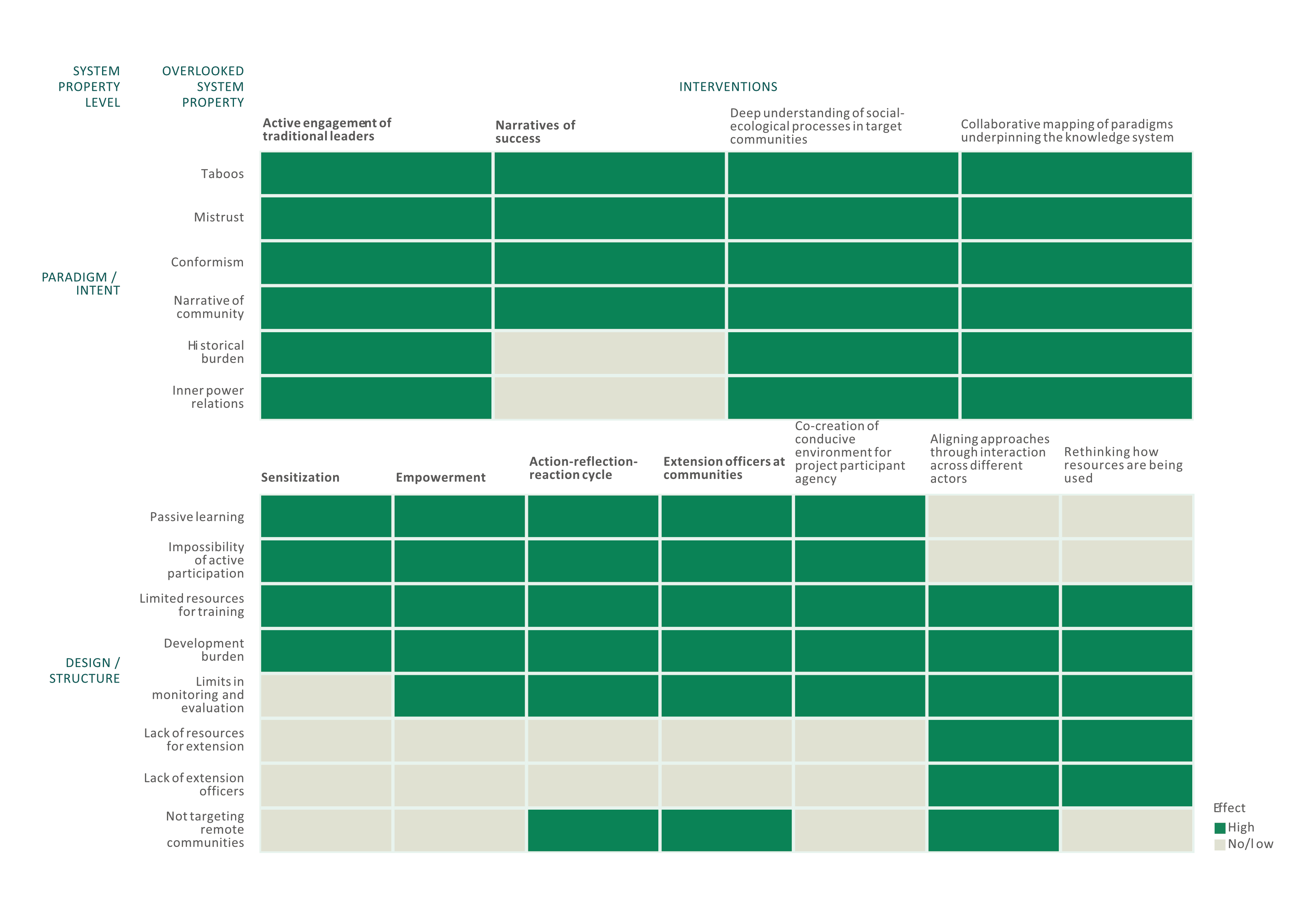
Figure: Summary of overlooked system properties of the Czech development cooperation knowledge system and related interventions to act upon them. Interventions in bold are proposed by the research participants. Interventions in the regular font are elaborated by the authors.
Why This Matters
Understanding and improving the flow of knowledge within development cooperation is essential for achieving more equitable and sustainable outcomes. By identifying and addressing the often overlooked aspects of knowledge systems, our research provides a pathway to more effective interventions that can help bridge gaps between development actors and local communities.
We hope this paper will spark further discussions and inspire new approaches in the field of development studies and sustainability science, particularly in contexts that are often shaped by complex and dynamic knowledge systems. Moreover, the theoretical and analytical approach applied in this paper allows for applicability in other UN SDG related agenda; the findings might therefore be utilized by practitioners, agenda-setters and other influential actors in other fields.
Project Coop4Wellbeing
This paper was written as an outcome of our team’s participation in project Coop4Wellbeing. The project aims to strengthen linkages among science, applied research, and Czech development cooperation. The main goal of the project was to initiate the utilization of knowledge emerging from collaborative research on social-ecological linkages in practice.










Leave a comment