
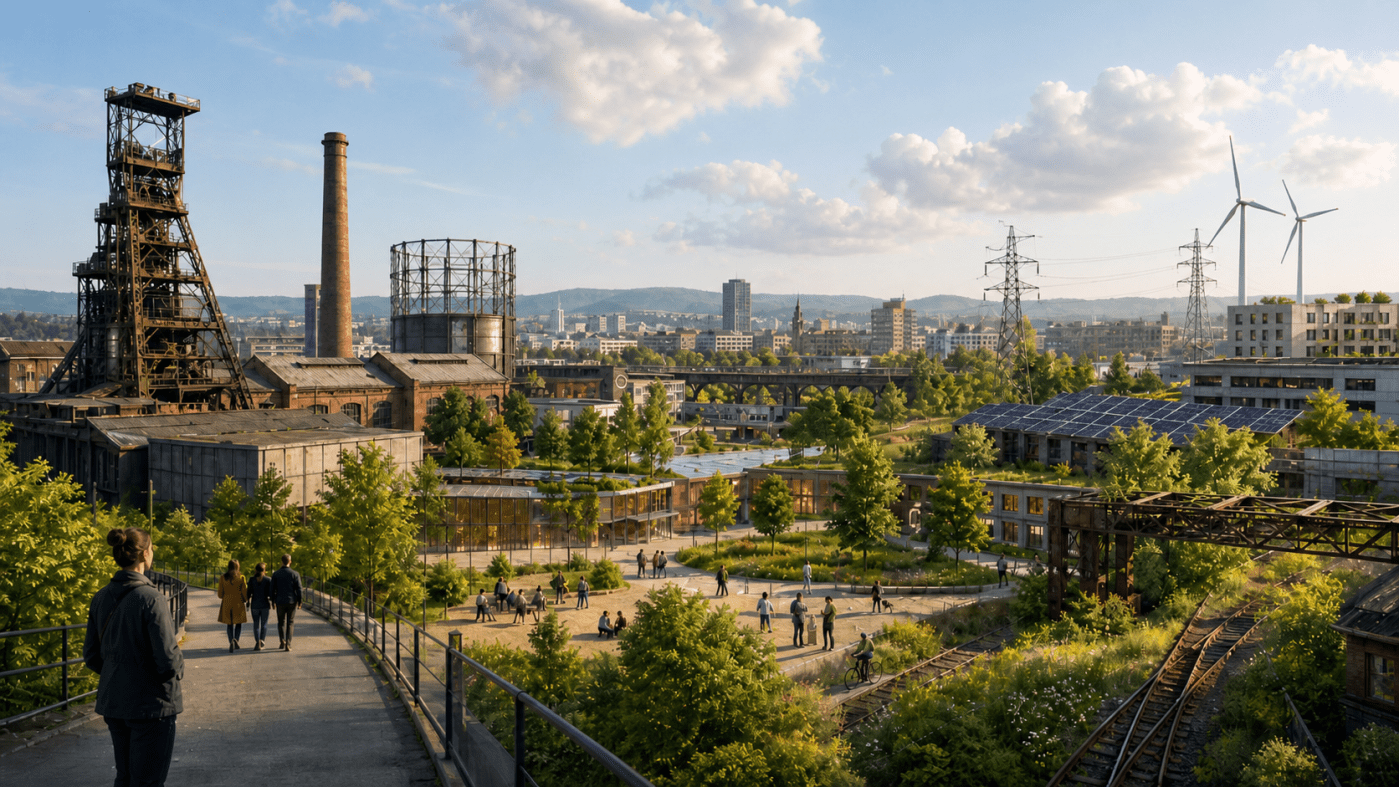
How can a city undergoing deep transformation become not only greener or more modern, but also more just? This question has guided our recent work in the STENEO project 🔗 (Social Dimension of New Energy Technologies in the Ostrava Metropolitan Area), where we have been developing a conceptual framework for analysing just urban transformation in Ostrava and testing how this framework can support document analysis and future empirical work.
Ostrava is a city shaped in important ways, among other influences, by industrial history, environmental burdens, energy infrastructures, post-industrial landscapes, and social inequalities. Its transformation is therefore not only a technical or economic process. It also raises important questions about who benefits from change, who bears its costs, whose voices are heard, and which places or groups remain overlooked. In our recent work, we tried to bring these issues together in a systematic way.
From urban transformation to justice
The first step was to develop a conceptual framework for thinking about Ostrava as a socio-ecological-technological system (Fig. 1). This means that the city is understood not simply as a social space, or a set of infrastructures, or an ecological environment, but as a system in which residents, institutions, green spaces, brownfields, energy systems, housing, transport, ecological functions and industrial legacies are deeply interconnected. This perspective is important as many urban problems cannot be placed into just a single category. A brownfield, for example, is more than a technical planning issue. It can also be a site of environmental burden, a potential space for ecological regeneration, a question of investment priorities, and a place connected to local memories. Similarly, energy transition is not just about decarbonisation; it also concerns affordability, vulnerability, infrastructure, and the distribution of benefits and risks.
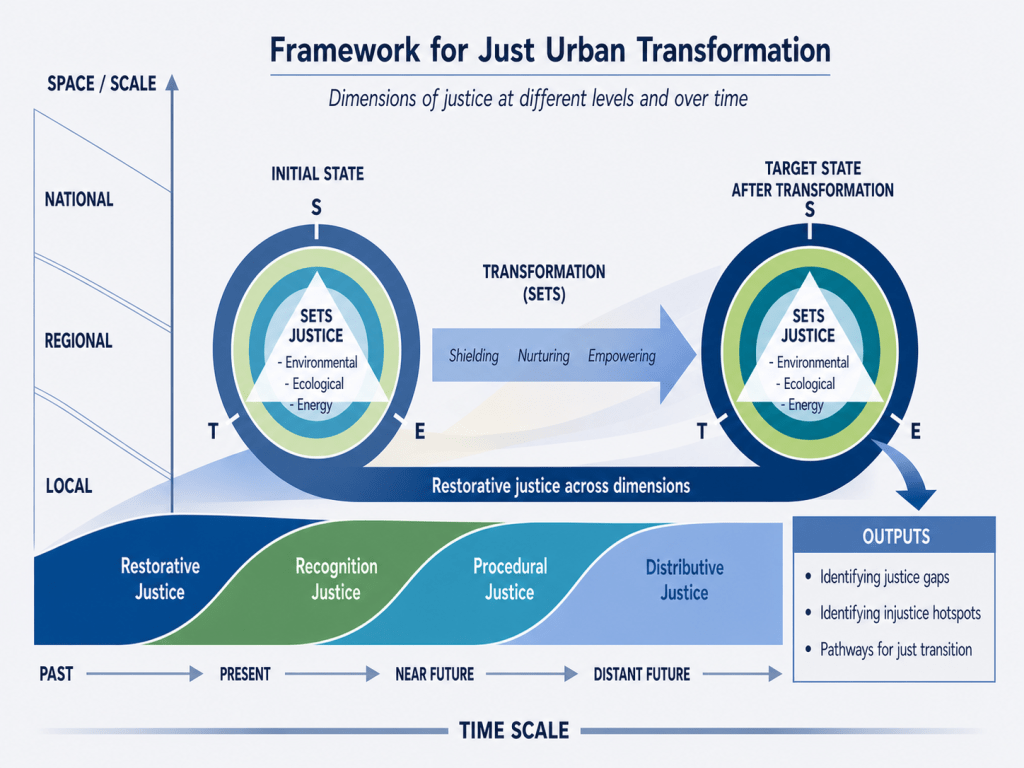
Fig 1. A Conceptual Framework for the Just Urban Transformation of Ostrava
At the centre of the framework are three interconnected forms of justice: environmental justice, ecological justice and energy justice. Environmental justice asks who is exposed to pollution, heat, noise or poor-quality environments, and who has access to green spaces and environmental benefits. Ecological justice extends attention to ecosystems themselves, asking whether ecological functions, biodiversity and regeneration are recognised and protected. Energy justice focuses on the social consequences of energy transformation, including energy vulnerability, costs, benefits and access to new opportunities.
A key part of the framework is that justice is analysed across both spatial and temporal scales. Spatially, injustices may appear at the local level, for example in particular neighbourhoods, streets or brownfields. But they may also be shaped by regional processes and national policies. This is especially important in Ostrava, where local impacts are often connected to broader regional restructuring and national energy or subsidy frameworks. Temporally, the framework asks us to look not only at present-day inequalities, but also at past harms and future consequences. This is where restorative justice becomes especially important. A just transformation cannot be approached as if the city had no history. It calls for consideration of long-term industrial burdens, neglected areas, environmental damage and social disadvantages that have accumulated over time. Recognition, procedural and distributive justice then help us ask what is acknowledged today, who is involved in decision-making, and how the benefits and burdens of future transformation will be distributed. In this sense, the framework intends to help identify where injustices are reproduced, where they are spatially concentrated, and what pathways could support a more just transformation.
What the framework reveals
The framework has three main practical outputs. The first is the identification of “justice gaps”. These are misalignments, blind spots or failures in how justice is considered in policies, strategies or implementation processes. For example, a document may declare ambitious goals but provide weak tools for implementation. A national policy may not fit local realities. A strategy may speak about improving quality of life, but does not identify who is most vulnerable or who should benefit first.
The second output is the identification of “injustice hotspots”. These are places where different forms of injustice overlap: for example, high heat exposure, limited access to good-quality greenery, poor housing conditions and social vulnerability. In the STENEO work, this is expected to lead to a set of maps and interpretations showing where environmental, social, ecological and energy-related vulnerabilities are concentrated in Ostrava.
The third output is the formulation of possible pathways to a just transition. This means moving from diagnosis to action: where participation should be strengthened, where investments should be targeted, where ecological regeneration is needed, and where energy transformation could otherwise worsen existing inequalities.
Reading documents through a justice lens
Alongside the conceptual work, we also started analysing strategic documents and policies at national, regional and local levels. The aim was not to produce a comprehensive policy review, but rather a brief and systematic analysis of the documents through a justice lens. We asked: Do the documents recognise vulnerable groups? Do they identify specific problem areas or priority territories? Do they consider risks such as displacement, gentrification or uneven distribution of benefits? Do they explain who is responsible for implementation, how measures will be financed, and how progress will be monitored?
Our analysis revealed an important pattern. Justice is usually not an explicit framework in the documents. Instead, the dominant language is sustainability, modernisation, competitiveness, infrastructure, development and quality of life. These are important goals, but they do not automatically answer justice-related questions. As a result, transformation is often framed more as a technical, economic or development task than as a question of fair distribution, recognition and participation.
At the national and regional levels, the weakest aspect appears to be the recognition of inequalities and vulnerable groups. The documents on these levels only partially identify who is most affected by transformation, who may bear its costs, and who is likely to receive its benefits. At the local level, the situation is somewhat better: there is stronger recognition of social vulnerability and local problems. However, another challenge appears here. Social vulnerability, climate adaptation, energy transition and spatial development are often addressed in separate sectoral documents. This creates fragmentation, even when individual documents contain useful insights.
Why this matters
This work matters because urban transformation is often discussed in optimistic terms: cleaner technologies, greener spaces, revitalised brownfields, improved infrastructure or new investment. Without a justice perspective, even positive changes can reproduce or deepen inequalities. Benefits may go to places that are already attractive for investment, while historically burdened or socially vulnerable areas remain neglected. New green spaces may improve the city, but also raise questions about housing affordability and displacement. Energy transition may support decarbonisation, but still leave vulnerable households struggling with costs. The STENEO framework helps to keep these questions visible. It reminds us that just transformation requires more than good intentions. It requires attention to history, recognition of vulnerability, meaningful participation, careful implementation, and spatially targeted responses.
Key take-home messages
- Justice needs to be made explicit: many strategies contain justice-related issues indirectly, but do not use justice as an organising framework. Making it explicit helps reveal who is recognised, who is missing, and how benefits and burdens are distributed.
- Urban transformation is systemic: social, ecological and technological dimensions cannot be analysed separately. Energy systems, brownfields, housing, green spaces and social vulnerability are connected.
- History matters: Ostrava’s transformation is shaped by long-term industrial, environmental and social legacies. A just transition must address past harms, not only future ambitions.
- Fragmentation is a challenge: at the local level, relevant issues may be recognised, but they are often spread across separate sectoral documents. Connecting these perspectives is necessary for more coherent action.
Next steps
The framework and document analysis create a basis for the next phase of the STENEO work. Planned interviews will help validate whether the identified justice gaps also appear in practice, how local actors understand them, and which issues they see as most important. The hotspot analysis will further support this by showing where different forms of vulnerability, environmental burden and ecological concern overlap spatially. By combining conceptual work, document analysis, interviews and mapping, the STENEO project aims to support a more grounded discussion about just urban transformation in Ostrava.
Co-author: Jana Osúchová









Leave a Reply